CROP+®
A foliar biostimulant crop treatment designed to support root development, crop emergence, shoot health, nutrient uptake, photosynthesis and plant performance under abiotic stress through two manufacturer-described modes of action: high antioxidant activity and gene activation.
Verdesian positions CROP+® as a nutritional technology that helps plants maintain metabolic efficiency during critical stages of development, particularly when drought, heat, cold or other non-biological stresses threaten growth, yield and quality.
Crop uses, rates, timings, formulation, tank-mix compatibility and registration differ by market. North American application directions shown later on this page are clearly identified and must not replace the current approved local EMEA label.
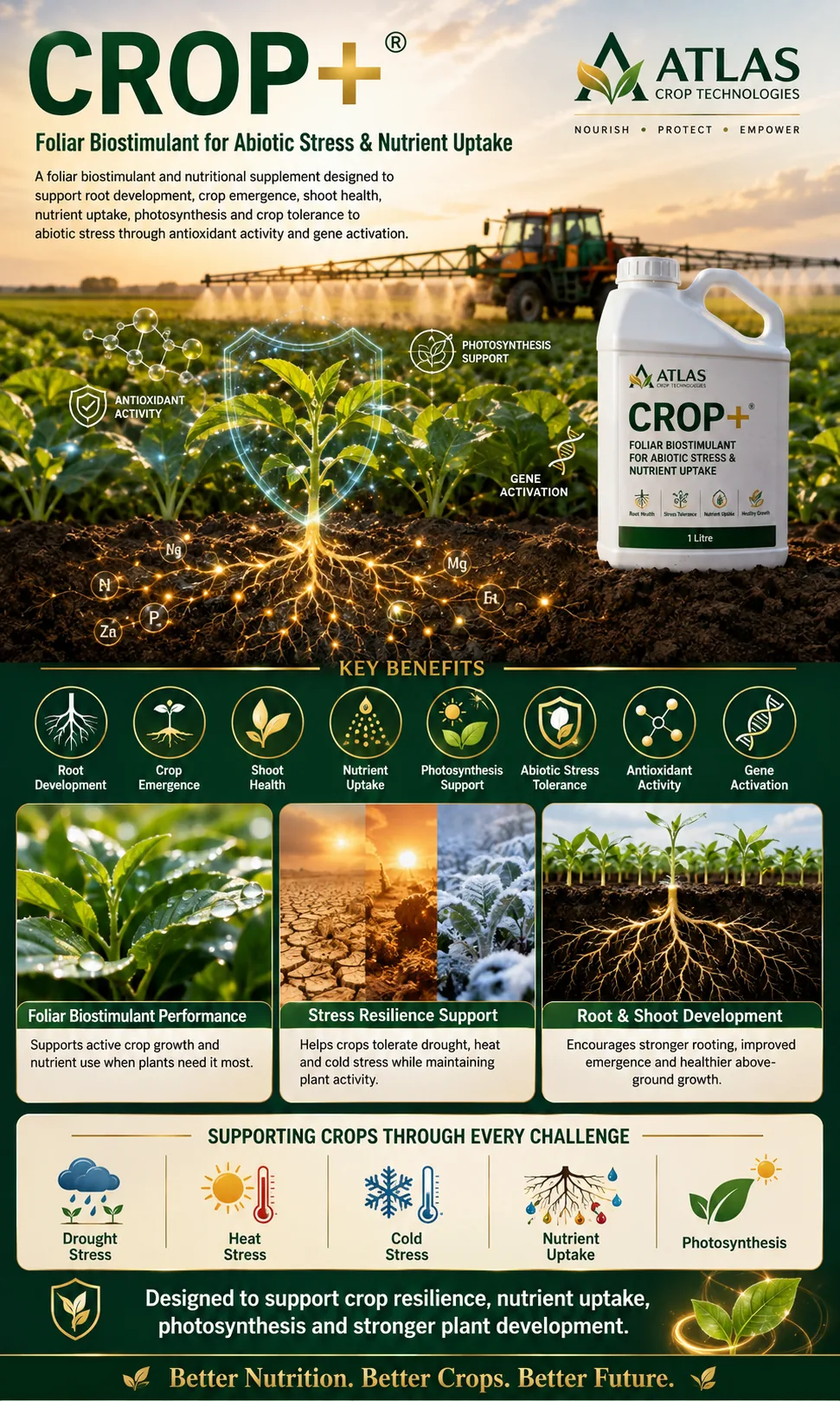
Helping crops maintain productive physiology when conditions become difficult
Crop yield potential is progressively influenced by the stresses a plant experiences from emergence through harvest.
Drought, heat, cold and other abiotic stresses can restrict photosynthesis, nutrient acquisition, cell expansion, membrane stability and reproductive development.
CROP+® is designed around plant physiological response rather than a single conventional nutrient-correction mechanism.
Verdesian describes a combination of antioxidant activity and metabolic gene activation intended to help plants perform more effectively under stressful growing conditions.
Current manufacturer profile
Antioxidant activity + gene activation
Current Verdesian Europe information explicitly identifies these two complementary mechanisms.
High antioxidant activity
Verdesian positions CROP+® antioxidant activity as helping reduce the negative effect of abiotic stress on plant growth.
This mechanism is particularly relevant when stress increases oxidative pressure within plant cells.
Gene activation
Verdesian states that CROP+® upregulates key genes associated with nutrient-use efficiency and plant metabolic systems.
In physiological terms, upregulation means altered gene expression and biological activity—not insertion or modification of plant DNA.
Abiotic stress can increase reactive oxygen species
Plants naturally produce reactive oxygen species, or ROS, during normal metabolism.
These compounds participate in cellular signalling, but excessive accumulation during severe environmental stress can damage cellular structures.
Drought, high temperature, chilling and other stresses can disturb the balance between ROS production and the plant's antioxidant systems.
Excess ROS can affect
Antioxidants regulate—not eliminate—oxidative chemistry
Reactive oxygen species are not exclusively harmful.
At controlled concentrations they function as signalling molecules involved in development and stress response.
Effective antioxidant physiology therefore involves maintaining cellular redox balance rather than simply removing every ROS molecule.
Reducing the negative impact of excessive stress
This should not be interpreted as complete elimination of oxidative stress or immunity to damaging environmental conditions.
Supporting plant metabolic response
Plants continuously adjust gene expression in response to light, temperature, water status, nutrients and developmental stage.
Verdesian describes CROP+® as increasing activity of key genes involved in important metabolic systems.
The manufacturer links this upregulation with improved nutrient-use efficiency and overall metabolic efficiency.
Gene expression ≠ genetic modification
Gene activation or upregulation refers to changing the activity of genes already present in the plant. It does not mean inserting foreign DNA or creating a genetically engineered plant.
Metabolic pathways associated with the CROP+® platform
Photosynthesis
Verdesian technical material links the platform with gene activity associated with photosynthesis and increased energy and carbohydrate supply.
Lipid metabolism
Lipids are important components of plant membranes, including the membranes whose stability can be affected by environmental stress.
Carbohydrate metabolism
Carbohydrates provide energy, transportable carbon and structural material for growing plant tissues.
Oxidation-reduction processes
Redox pathways are central to photosynthesis, respiration, antioxidant defence and stress signalling.
Enhanced photosynthesis
Verdesian lists enhanced or increased photosynthesis among current CROP+® benefits.
Photosynthesis converts light energy and atmospheric carbon dioxide into chemical energy and carbon compounds that support crop growth.
Maintaining photosynthetic activity during periods of environmental stress can be important because reduced carbon assimilation can quickly constrain both root and shoot development.
Fixed carbon supports
Building a stronger below-ground foundation
Current Verdesian Europe information explicitly lists improved root development among CROP+® benefits.
Roots determine the volume of soil a crop can explore for water and mineral nutrition.
Root-system performance depends on total root length, rooting depth, branching, fine-root development, root hairs and physiological health.
Strong roots support
Crop emergence sets the initial yield platform
Verdesian's current European page includes crop emergence within CROP+® product positioning.
Uniform emergence helps establish a consistent crop canopy and can reduce competitive differences between early and late plants.
Soil temperature, seed quality, moisture, planting depth and crusting remain major drivers of emergence and cannot be replaced by a foliar treatment.
Manage together
Maintaining productive leaf area
Current European manufacturer positioning specifically mentions improved shoot health.
Healthy shoots create the photosynthetic canopy needed to intercept light and generate carbohydrates.
Maintaining functional leaf tissue is therefore directly connected with both current growth and future root support.
Influenced by
Improved nutrient uptake
Availability
Nutrients must first be present in plant-accessible forms.
Root access
Roots must physically encounter or receive nutrients through diffusion and mass flow.
Root activity
Healthy membranes and transport systems are required for active uptake.
Water movement
Transpiration and soil water help move many dissolved nutrients toward roots.
Metabolic demand
Crop nutrient uptake frequently changes with physiological demand.
Assimilation
Nutrients must be incorporated into productive metabolism after uptake.
Supporting the plant's efficiency—not creating nutrients
Verdesian Europe states that upregulation of key genes improves nutrient-use efficiency and the efficiency of plant metabolic systems.
Nutrient-use efficiency describes how effectively available nutrients contribute to productive plant growth and yield.
Maintain a complete fertility program
Improved uptake or metabolic efficiency requires adequate nutrient supply and should not automatically be used to reduce fertiliser rates.
Current manufacturer focus: drought · heat · cold
Drought
Water deficit can restrict stomatal conductance, photosynthesis, nutrient transport and cell expansion.
Heat
Excessive temperature can disrupt proteins, cellular membranes, pollen function and photosynthetic processes.
Cold
Low temperature can slow metabolic reactions, root activity, membrane transport and nutrient uptake.
CROP+® should not be described as making crops drought-proof, heat-proof or frost-proof. Severe environmental stress still requires appropriate irrigation, planting-date, cultivar and crop-management decisions.
Other non-biological stresses can also restrict plant physiology
Although Verdesian's current European product page specifically highlights drought, heat and cold, general crop physiology is also affected by salinity, waterlogging, nutrient imbalance and other environmental constraints.
Those broader examples are agronomic context rather than additional product-specific manufacturer claims.
Abiotic vs biotic stress
Stress timing can matter as much as stress severity
Verdesian describes CROP+® as supporting plant metabolism at critical stages that influence yield and quality. Exact treatment timing must follow the current local label.
Early vegetative development
Root and shoot architecture establish the crop's capacity for future resource capture.
Rapid canopy growth
Expanding leaf area increases demand for water, nutrients and photosynthetic carbon.
Reproductive transition
Heat, drought and nutrient stress around flowering can strongly influence reproductive success in many crops.
Pod, grain or fruit establishment
Resource supply during early yield formation helps determine the number of reproductive sinks maintained.
Yield accumulation
Continued photosynthesis and nutrient remobilisation contribute to grain, seed or fruit filling.
Maturation
Final quality depends on crop genetics, environment, maturity and nutrient balance.
Foliar delivery
Current Verdesian Europe and global product information identifies foliar application for CROP+®.
Foliar spraying places the formulation directly onto exposed plant surfaces at a selected growth stage.
Successful application depends on the current crop-specific rate, adequate deposition, suitable weather and tank-mix compatibility.
Control
Crop-specific timing and rates
These are current Verdesian global-page directions. They are included for technical context only and must not be transferred automatically to European, Middle Eastern or African labels.
600 mL/ha
Current manufacturer timing: one application at the 6–8 leaf stage.
US label expression: 8 fl oz/acre.
600 mL/ha
Current manufacturer timing: two applications—pre-bloom and pod-set.
US label expression: 8 fl oz/acre.
300 mL/ha
Current manufacturer timing: four weekly applications beginning at pinhead square.
US label expression: 4 fl oz/acre.
The rates and timings above reflect current global / North American manufacturer information. For crops in Europe, the Middle East or Africa, always use the rate and timing on the current local CROP+® label.
UK and Italy digital content currently listed
Verdesian's current European CROP+® page lists country-specific digital content for:
Do not extrapolate across EMEA
It does not establish identical registration, formulation, rates or commercial availability throughout Europe, the Middle East or Africa.
Biologically derived nutritional technology
Verdesian technical material describes CROP+® as a biologically derived nutritional supplement.
Manufacturer technical descriptions identify a combination of fermentation-derived materials, micronutrient components and plant-derived materials.
Manufacturer technical literature includes
Exact guaranteed analysis and ingredient concentrations must be taken from the current market-specific label and SDS.
Fermentation metabolites
Fermentation processes can produce a complex mixture of biologically derived compounds.
Verdesian identifies fermentation metabolites as part of the technical composition background for CROP+®.
This page does not assign individual metabolite concentrations that are not published on the current market label.
Avoid unsupported ingredient extrapolation
Naturally chelated micronutrients
Verdesian technical background identifies naturally chelated micronutrients among the components of CROP+®.
Micronutrients participate in enzyme systems, photosynthesis, antioxidant processes and other metabolic pathways.
Exact micronutrient identities and guaranteed percentages should always be confirmed from the current locally supplied product label.
CROP+® does not replace diagnosed micronutrient correction
Natural adjuvants
Verdesian's technical description distinguishes CROP+® from SEED+DRY by noting that CROP+® also contains natural adjuvants.
In general foliar formulation, adjuvant components can influence wetting, spreading, retention or deposition behaviour.
The exact function of the CROP+® adjuvant system should be described only according to current manufacturer documentation.
Do not automatically add more adjuvant
Follow the CROP+® label and all tank-mix partner labels.
Application quality determines how much spray reaches the crop
Deposition
Droplets must reach the target canopy rather than drift off target.
Retention
Spray deposits must remain on plant surfaces rather than bounce or run off.
Coverage
Appropriate nozzle and carrier volume help distribute treatment across the intended canopy.
Drying environment
Temperature and humidity affect droplet lifetime after deposition.
Leaf condition
Waxiness, age, dust and crop stress can influence surface interaction.
Timing
Application should coincide with label-approved crop stages and suitable environmental conditions.
Stress-management products still require crop-safe application weather
Extreme heat
Hot conditions accelerate evaporation and can increase crop stress.
Low humidity
Very dry air can shorten spray-droplet hydration time.
Wind
Excessive wind can reduce deposition and increase drift.
Rain
Rain shortly after treatment may remove material before sufficient foliar interaction occurs.
Severely wilted crop
A crop under extreme water deficit may not respond like an actively growing crop.
Frost conditions
Avoid unlabelled application to frozen or severely cold-damaged tissue.
Water quality can affect a foliar tank mix
Water pH, hardness, alkalinity, dissolved salts and suspended material can influence agricultural formulations.
This becomes increasingly important when CROP+® is mixed with crop protection products or other nutritionals.
Check where relevant
Verify every proposed mixture
Foliar biostimulants may be considered alongside fungicides, insecticides, herbicides, micronutrients or foliar fertilisers where labels permit.
Physical compatibility, crop safety and legal tank-mix use should be verified independently.
Do not assume compatibility simply because two products can each be applied to the same crop.
Check
Physical compatibility test
Where all labels permit a proposed mixture but its physical compatibility is uncertain, a proportional jar test using the intended spray water can help identify obvious problems.
Reproduce intended concentrations and order of addition as closely as practical.
Potential warning signs
CROP+® complements rather than replaces essential nutrients
Nitrogen
Required for proteins, chlorophyll, enzymes and new vegetative tissue.
Phosphorus
Required for energy transfer, membranes and root development.
Potassium
Supports water regulation, transport and enzyme activation.
Sulphur
Required for sulphur-containing amino acids and protein synthesis.
Magnesium
Central to chlorophyll and numerous metabolic enzymes.
Micronutrients
Small quantities can be essential for enzyme, redox and reproductive processes.
Root development cannot fully overcome unsuitable soil chemistry
Even if root growth improves, nutrient uptake may remain restricted when soil pH, salinity or nutrient availability is severely limiting.
CROP+® should therefore be integrated with soil-testing and root-zone management rather than treated as a replacement.
Root-zone conditions
Biostimulation cannot replace correction of severe field problems
Severe drought
Maintain adequate irrigation where irrigation is available.
Waterlogging
Improve drainage and root-zone aeration where possible.
Compaction
Physically restricted roots may require soil-structure management.
Salinity
Manage water quality, leaching, drainage and salt loading.
Root disease
Diagnose pathogens and implement an appropriate crop-protection strategy.
Severe nutrient deficiency
Supply the deficient nutrient in an agronomically effective form and rate.
Determine why the crop is underperforming
Soil analysis
Evaluate pH, nutrient supply, salinity and root-zone conditions.
Tissue analysis
Measure actual crop nutrient status.
Root inspection
Check depth, branching, disease and physical restriction.
Canopy symptoms
Record chlorosis, scorching, rolling, wilting or uneven growth.
Weather history
Review heat, cold, rainfall and drought events surrounding symptom onset.
Field pattern
Spatial patterns can help separate environmental, soil and application-related causes.
CROP+® has also been discussed in herbicide-drift stress situations
Verdesian has published grower case-study material describing use of CROP+® on grapevines showing symptoms associated with off-target herbicide exposure.
The manufacturer frames herbicide injury as a stress situation in which antioxidant and metabolic support may be relevant.
Do not present CROP+® as an antidote
Off-target herbicide injury should be documented and managed through appropriate agronomic and regulatory procedures.
Helping the crop move closer to genetic potential
Verdesian Europe states that the combination of CROP+® antioxidant and gene-activation mechanisms helps plants get closer to their genetic potential.
Genetic potential is an upper biological ceiling rather than a yield guarantee.
Actual harvested yield remains the result of genetics interacting with weather, soil, fertility, water, pests, diseases and management.
CROP+® operates within
Quality is crop-specific
Verdesian's global product positioning links CROP+® with improved crop yield and quality.
Quality metrics depend strongly on crop and market.
Depending on crop
Stress-responsive field-trial results
Verdesian technical material published in 2019 discussed historical Winfield trial data in which CROP+® responses were evaluated under stressed conditions.
That material reported approximately a 5.3% soybean-yield response in the cited trial program and a mean corn response described as approximately 10 bu/acre at stressed locations.
Not a current universal guarantee
They should not be used as guaranteed yield claims for a current European CROP+® program without locally relevant supporting data.
Measure CROP+® response objectively
Root development
Compare root depth, branching and root-system size where practical.
Canopy development
Record biomass, plant height, leaf area or other crop-specific metrics.
Tissue nutrients
Tissue analysis may help quantify nutrient-status differences.
Stress symptoms
Score leaf rolling, scorch, wilting or other relevant symptoms using a consistent scale.
Yield
Use representative treated and untreated comparisons.
Quality
Measure market-relevant crop quality rather than relying only on visual appearance.
Field variability can hide or exaggerate product response
Soil type, drainage, elevation and previous management can create yield differences unrelated to a treatment.
Replication and comparable treated / untreated strips provide more useful information than one isolated comparison.
Trial information
The Fertilizer Institute Certified Biostimulant designation
On July 13, 2026, Verdesian announced that CROP+® had received a Certified Biostimulant designation through The Fertilizer Institute's Certified Biostimulant Program.
Verdesian states that the independent review considered efficacy, safety and composition, including demonstrated plant response.
Important regulatory distinction
It should not be described as EU registration, CE marking, pesticide approval or universal EMEA regulatory authorisation.
Crop+® Organic is a separate certification context
Verdesian announced in 2025 that Crop+® Organic received OMRI certification for the US organic market.
That information relates specifically to the manufacturer-designated Organic version.
Standard CROP+® ≠ automatic organic approval
Organic-input eligibility must be checked for the exact product, country and certification scheme.
Biostimulants work within a sound fertility program
Improving nutrient uptake or metabolic efficiency does not replace supplying the nutrients required to produce the crop.
CROP+® is best integrated with soil testing, crop monitoring and 4R nutrient-management principles.
Right source · rate · time · place
Protect product integrity before spraying
Keep original container
Maintain manufacturer labelling and lot traceability.
Follow label storage conditions
Use the current product label and SDS for temperature and storage requirements.
Prevent contamination
Use clean measuring and transfer equipment.
Use appropriate PPE
Follow the SDS and local workplace-safety requirements.
Manage spills responsibly
Follow SDS and local environmental procedures.
Record applications
Maintain crop, field, rate, timing, lot and tank-mix records.
Avoid common CROP+® program mistakes
Calling gene activation genetic modification
Gene-expression changes do not mean plant DNA has been genetically engineered.
Treating antioxidant activity as complete ROS removal
ROS also have normal signalling functions; biological redox balance is complex.
Using US rates in Europe
Current US/global rates must not replace local EMEA label directions.
Using CROP+® as a drought substitute
Improved stress tolerance does not replace water required by the crop.
Ignoring severe nutrient deficiency
Correct diagnosed nutrient deficiencies using appropriate fertiliser.
Assuming improved uptake means lower fertiliser rate
Do not reduce nutrients automatically without validated agronomy.
Ignoring water quality
Water chemistry can affect foliar tank mixtures.
Adding unnecessary adjuvant
CROP+® already contains manufacturer-described natural adjuvants.
Assuming TFI certification equals EU registration
Industry certification and regulatory registration are different.
Assuming standard CROP+® is automatically organic-approved
Crop+® Organic has separate OMRI certification context.
Expecting a yield response without stress
Manufacturer technical discussion itself notes that response may be smaller when growing conditions are already optimal.
Assuming universal EMEA registration
Confirm the exact current local product documentation before use or sale.
Information that helps us evaluate a CROP+® program
Country
Determines local registration, crop use, rate and label.
Crop
Include crop species, variety and production system.
Growth stage
Helps determine whether timing aligns with label and physiological objective.
Stress type
Drought, heat, cold or another relevant environmental constraint.
Stress severity
Describe whether conditions are preventive, moderate or severely damaging.
Current label rate
Provide the locally approved CROP+® rate being considered.
Water volume
Helps evaluate foliar coverage and tank concentration.
Water quality
Include pH and hardness where known.
Tank-mix partners
List pesticides, foliar fertilisers and adjuvants.
Soil analysis
Provides background fertility and root-zone context.
Tissue analysis
Helps determine whether nutrient uptake is already limiting.
Crop area
Supports technical and commercial volume planning.
CROP+® product profile
Explore related technologies
Lyra
A fertigation enhancer formulated to improve nutrient availability and uptake while supporting crop performance under abiotic stress.
View Product → FoliarMagnum
A foliar nutrient complex developed to improve nutrient management, root development and crop quality.
View Product → FoliarMagnum S
A Nutriphite® foliar nutrient complex supporting root development, nutrient uptake and efficient crop establishment.
View Product →Build a crop-specific CROP+® stress-management program
Tell us your country, crop, growth stage, stress type, current local CROP+® rate, spray-water volume, water quality, tank-mix partners, soil and tissue analysis, field area and technical objective. Atlas Crop Technologies can help evaluate the product within your wider crop-nutrition and stress-management strategy.
Frequently Asked Questions
Manufacturer-specific claims are identified as such. General explanations provide agronomic context. Always follow the current approved local CROP+® label.
CROP+® is a Verdesian foliar biostimulant and nutritional supplement positioned to support root development, emergence, shoot health, nutrient uptake, photosynthesis and crop tolerance under abiotic stress.
Current Verdesian Europe information describes high antioxidant activity and gene activation / upregulation as the two key modes of action.
Verdesian positions the antioxidant component as helping reduce negative crop-growth effects associated with abiotic stress and excessive oxidative pressure.
Reactive oxygen species are chemically reactive oxygen-containing compounds produced during normal plant metabolism and often at increased levels during stress.
No. ROS also participate in normal signalling. Problems arise when production exceeds the plant's ability to maintain redox balance.
It refers to increased or altered expression of genes already present in the crop, affecting metabolic activity.
No. Gene upregulation is not genetic engineering and does not mean foreign DNA is inserted into the plant.
Yes. Enhanced or increased photosynthesis is listed by Verdesian among CROP+® product benefits.
Yes. Improved nutrient uptake is a current manufacturer-listed benefit.
Verdesian Europe states that upregulation of key genes improves nutrient-use efficiency and overall metabolic-system efficiency.
Do not assume an automatic fertiliser reduction. Essential nutrients must still be supplied according to crop demand and locally validated fertility recommendations.
Yes. Root development is specifically included in current Verdesian Europe product positioning.
Crop emergence is included in current European product positioning. Emergence still depends heavily on seed quality, soil moisture, temperature and planting conditions.
Shoot health refers broadly to the condition and productive development of above-ground crop tissues such as stems and leaves.
The current European page specifically highlights drought, heat and cold as abiotic stresses.
No. Improved tolerance does not replace the water required for normal crop growth.
Do not describe CROP+® as frost protection unless a current local label specifically supports such a claim. Cold-stress tolerance is not the same as frost immunity.
No universal salinity-correction claim should be assumed. Severe salinity requires water, drainage and soil-management strategies.
Current manufacturer information lists foliar application.
Use the current approved local European CROP+® label. Do not automatically transfer global or North American rates.
Current global Verdesian guidance lists 600 mL/ha at the 6–8 leaf stage for corn, milo, millet and sorghum. This is geography-specific guidance.
Current Verdesian guidance lists 600 mL/ha with applications at pre-bloom and pod-set. Use the current local label outside that market.
Current global Verdesian guidance lists 300 mL/ha in four weekly applications beginning at pinhead square.
Product registration, crop use and rates can differ by country, so geography-specific manufacturer directions should not be transferred to another market without label support.
Verdesian technical material describes fermentation metabolites, naturally chelated micronutrients, plant extracts and natural adjuvants. Exact current composition should be confirmed on the relevant label.
Verdesian technical literature describes naturally chelated micronutrients as part of the formulation platform. Exact nutrient identities and percentages should be taken from the current local guaranteed analysis.
Verdesian technical material states that CROP+® contains natural adjuvants.
No. Because the product already contains a manufacturer-described adjuvant system, additional adjuvants should follow current CROP+® and tank-mix partner labels.
Check the current CROP+® label and all partner-product labels. Do not assume universal compatibility.
Yes. pH, hardness, bicarbonates and dissolved salts can affect complex foliar mixtures.
Where all labels permit a mixture but physical compatibility is uncertain, a proportional jar test can help identify gross incompatibility. It does not prove crop safety.
No. Verdesian links CROP+® with improved yield potential, but actual yield depends on genetics, environment, fertility, water and management.
Verdesian technical discussion has noted that where growing conditions are already optimal and little stress is present, less product response may be expected because yield potential remains high.
Verdesian announced in July 2026 that CROP+® earned The Fertilizer Institute Certified Biostimulant designation.
Verdesian states that the independent certification review evaluates efficacy, safety and composition, including demonstrated plant response.
No. It is an industry certification and is not equivalent to EU registration, CE marking or universal EMEA authorisation.
Verdesian separately markets Crop+® Organic, which received OMRI certification in the United States. Standard CROP+® should not automatically be represented as organic-approved everywhere.
Yes. Verdesian maintains a current European CROP+® product page and currently lists UK and Italy digital content.
No universal registration should be assumed. Check current country-specific availability and label directions.
Use comparable treated and untreated areas and record crop stage, stress conditions, rate, water volume, tank mix, root and canopy development, yield and relevant quality measurements.
Include country, crop, variety, growth stage, stress type, current local label rate, water volume, water quality, tank-mix partners and any soil or tissue analysis.
Include company, country, target crops, crop area, annual product requirement, season and distribution structure.
Current Verdesian Europe information describes CROP+® as a foliar biostimulant crop treatment that supports root development, crop emergence, shoot health, nutrient uptake and plant tolerance under abiotic stress, leading toward improved crop yield potential.
The manufacturer identifies two key modes of action: high antioxidant activity and gene activation / upregulation.
Verdesian states that upregulation of key genes improves nutrient-use efficiency and overall efficiency of plant metabolic systems. Gene upregulation should not be confused with genetic modification; it describes changes in gene expression rather than insertion of foreign DNA.
Manufacturer technical material associates the CROP+® / SEED+ platform with metabolic processes including photosynthesis, lipid metabolism, carbohydrate metabolism and oxidation-reduction reactions.
Verdesian states that CROP+® high antioxidant activity helps reduce negative crop-growth effects associated with abiotic stress, particularly drought, heat and cold. This does not mean CROP+® eliminates reactive oxygen species or makes crops immune to severe environmental stress.
Enhanced photosynthesis and improved nutrient uptake are current manufacturer-listed benefits. These responses require a functioning crop and adequate supplies of water and essential nutrients.
CROP+® does not create fertiliser nutrients and should not automatically be used to reduce nitrogen, phosphorus, potassium, sulphur or micronutrient inputs.
Verdesian technical material describes CROP+® as a biologically derived nutritional supplement containing fermentation metabolites, naturally chelated micronutrients and plant extracts, with CROP+® additionally containing natural adjuvants. Exact guaranteed analysis and ingredient concentration must be confirmed on the current local label and SDS.
Current global / North American manufacturer guidance lists: corn, milo, millet and sorghum at 600 mL/ha applied once at the 6–8 leaf stage; soybean at 600 mL/ha at pre-bloom and again at pod-set; and cotton at 300 mL/ha in four weekly applications beginning at pinhead square.
Those crop-specific rates and timings are geography-specific manufacturer directions and must not automatically be transferred to Europe, the Middle East or Africa. The current approved local CROP+® label always controls use.
Verdesian's current European product page lists digital content for the UK and Italy. This does not establish identical registration, rate, formulation or commercial availability across all EMEA markets.
On July 13, 2026, Verdesian announced that CROP+® received The Fertilizer Institute Certified Biostimulant designation following independent review for efficacy, safety and composition. That industry certification must not be represented as EU registration, CE marking, pesticide authorisation or universal EMEA approval.
Verdesian separately markets Crop+® Organic, which received OMRI certification in the United States in 2025. That should not be used to imply that every standard CROP+® formulation is approved for organic farming in every market.
Foliar performance depends on application rate, crop stage, spray coverage, weather, water quality, tank-mix chemistry and crop physiological condition.
CROP+® complements rather than replaces balanced fertility, irrigation, drainage, soil-pH management, root-health management and crop protection.
Product formulation, analysis, rates, timings, crops, compatibility, registration, packaging and approved claims may differ by jurisdiction.
Always read and follow the current approved local CROP+® label and Safety Data Sheet. Consult a qualified agronomist, crop adviser or Atlas Crop Technologies representative for crop-specific timing, rate, compatibility and program integration.