N-Charge®
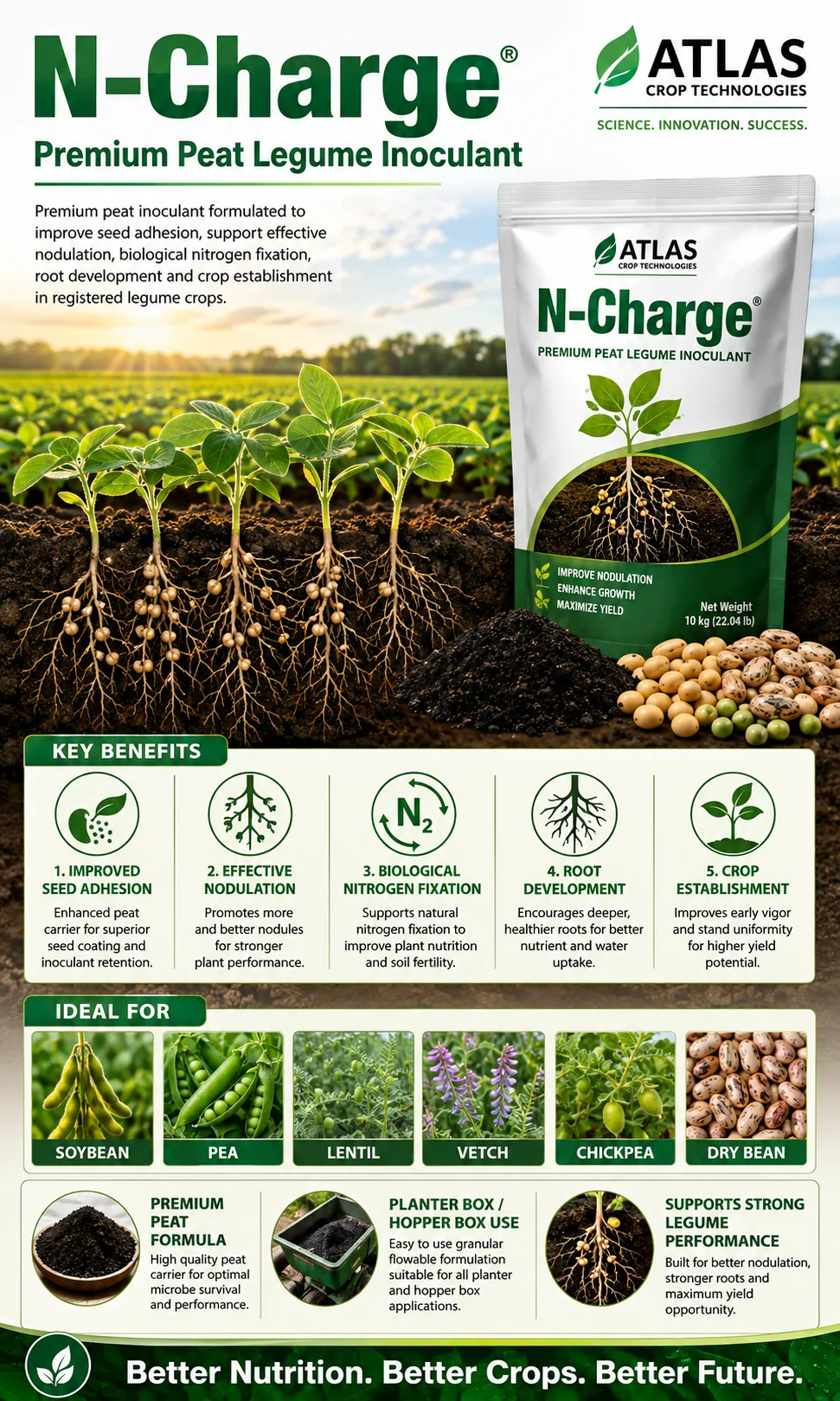
A premium peat inoculant formulated to improve seed adhesion, keep more compatible rhizobia close to the developing root zone and support effective nodulation, biological nitrogen fixation, root development and crop establishment.
N-Charge® is designed for simple hopper- or planter-box treatment. Current Verdesian information states that the formulation can improve seed adhesion by as much as 150% compared with traditional planter-box inoculants, helping retain more inoculant on seed during handling and planting.
N-Charge® crop formulations, rhizobial strains, application rates, viable-cell guarantees, pack sizes and registrations differ by country. Always use the current crop-specific local label.
Keeping the inoculant where it matters
Successful inoculation begins by placing enough viable, compatible rhizobia close to emerging legume roots.
Peat inoculants are designed to carry rhizobial bacteria and allow those microorganisms to be applied directly around seed during planting.
N-Charge® adds an adhesion-focused formulation concept. The manufacturer positions improved adhesion as helping more inoculant remain associated with seed rather than separating during handling, hopper movement and planting.
Better retention on seed increases the probability that rhizobia are deposited close to the root zone where early infection and nodule formation occur.
Technical positioning
Why peat is used as a rhizobial carrier
Peat-based inoculants provide a carrier material in which rhizobial bacteria can be formulated, stored and distributed onto seed.
The carrier helps protect the biological organisms while providing a physical medium that can coat seed surfaces.
Once seed is planted, the objective is for viable bacteria to remain close enough to germinating roots to begin the host-recognition and infection process.
What matters in a peat inoculant
Up to 150% greater seed adhesion
Current Verdesian information states that N-Charge® has been formulated to increase seed adhesion over traditional planter-box inoculants by as much as 150%.
This is important because inoculant that remains attached to seed is more likely to be carried through the planter and deposited near the germinating root.
Better adhesion therefore supports the physical placement step that precedes biological infection and nodulation.
Adhesion supports inoculant placement
The “up to 150%” figure is manufacturer-reported comparative performance and should not be interpreted as a guaranteed adhesion increase in every seed-treatment or planting system.
From inoculated seed to fixed nitrogen
Inoculation supports a biological process that begins near the seed and ultimately takes place inside functional root nodules.
Inoculant adheres to seed
N-Charge® is distributed around seed in the planter or hopper box.
Seed enters soil
Inoculant and viable rhizobia are deposited near the germination zone.
Roots emerge
Young roots release compounds that interact with compatible soil microorganisms.
Rhizobial infection occurs
Compatible bacteria recognise the host and enter susceptible root tissue.
Nodules develop
The plant develops specialised structures that house the nitrogen-fixing bacteria.
Atmospheric N₂ is fixed
Rhizobia within effective nodules convert atmospheric nitrogen into reduced nitrogen compounds that enter plant metabolism.
The crop and bacteria work together
Nitrogen fixation inside legumes is a symbiotic exchange.
The plant supplies carbon compounds generated through photosynthesis to the bacteria.
In return, compatible rhizobia fix atmospheric nitrogen within functional root nodules and supply reduced nitrogen to the host plant.
This biological relationship is energetically expensive, which is why healthy leaves, roots, water supply and balanced nutrition all influence fixation performance.
Effective fixation needs all parts of the system
Rhizobia are not universally interchangeable
Different legumes form effective symbioses with different rhizobial groups and strains.
An inoculant designed for soybean should not automatically be used on pea, lentil, chickpea or dry bean.
N-Charge® therefore exists as crop-specific formulations or SKUs, and growers should select the product identified for the target crop.
Crop-specific N-Charge® formulations
This crop portfolio reflects current manufacturer listings for North America. It does not establish registration for all crops in EMEA.
Current U.S. and Canadian crop formulations
Manufacturer SKU listings demonstrate the importance of selecting the correct crop-specific N-Charge® formulation.
Pea · Vetch · Lentil
Current manufacturer listings include a combined N-Charge® formulation for these pulse and forage-legume crops.
Chickpea · Garbanzo
Current manufacturer listings include a dedicated chickpea / garbanzo formulation.
Dry Bean
Current manufacturer listings include a dedicated dry-bean product.
Soybean
Current manufacturer listings include dedicated soybean N-Charge® SKUs.
Hopper-box / planter-box inoculation
N-Charge® is designed as a planter-box or hopper-box inoculant.
The peat inoculant is applied to seed around planting time rather than relying on a separate liquid application system.
The approach allows inoculant to be introduced directly into the seed-handling system and carried with seed to the soil.
No slurry preparation required
Current Verdesian information states that N-Charge® eliminates the need to make a slurry when used as a hopper-box treatment.
This can simplify inoculation operations by reducing liquid mixing and additional preparation steps.
Practical planter-box application principles
Confirm crop-specific product
Verify that the N-Charge® formulation and label match the intended legume.
Determine seed quantity
Accurately estimate seed mass or units that will be planted.
Calculate inoculant requirement
Use only the current crop-specific label rate.
Apply uniformly
Distribute inoculant through the seed mass so all seed receives appropriate exposure.
Maintain seed flow
Confirm inoculated seed continues moving consistently through the planter system.
Plant promptly
Current manufacturer guidance recommends planting inoculated seed as soon as possible.
Plant inoculated seed as soon as possible
Current Verdesian information explicitly recommends planting seed soon after N-Charge® inoculation.
Living rhizobia are exposed to drying, heat, chemical seed treatments and time once they leave the protected product package.
Prompt planting helps shorten this exposure period and positions the bacteria into the soil environment where root infection can begin.
Re-inoculate if planting is delayed
If inoculated seed has not been planted within 24 hours, Verdesian recommends re-inoculation.
Always confirm the exact requirement on the current crop-specific product label, particularly where other seed-treatment products are present.
Designed for practical planter performance
Seed inoculation needs to achieve biological coverage without creating operational problems in the planter.
Current Verdesian positioning describes N-Charge® as easy to apply and designed to avoid seed bridging or lodging.
Consistent seed flow remains important because irregular planter feeding can affect plant population and spacing even when biological inoculation is otherwise successful.
Check before and during planting
Effective nodules are the biological objective
Seed adhesion is valuable because it supports the chain of events that leads to successful root infection and nodule development.
Early infection
Compatible rhizobia must encounter young susceptible root tissue during crop establishment.
Nodule number
Adequate nodule formation provides evidence that the biological relationship has been established.
Nodule position
Crown and primary-root nodules can indicate relatively early root infection near the seed zone.
Nodule activity
Nodule number alone does not confirm effective nitrogen fixation; biological activity must also be considered.
Pink internal tissue is a useful field indicator
Effective legume nodules often develop pink or reddish internal tissue associated with leghemoglobin.
Leghemoglobin helps regulate oxygen inside nodules, supporting bacterial respiration while protecting the oxygen-sensitive nitrogenase system involved in nitrogen fixation.
Inspect nodules rather than guessing
Healthy roots support successful biological fixation
Rhizobial inoculation depends on living roots.
The crop must first germinate successfully, establish healthy root growth and generate susceptible tissues for bacterial infection.
Root development also determines access to water, phosphorus, potassium, sulphur and micronutrients that help sustain the energy-demanding nitrogen-fixation process.
Conditions that influence rooting
Rhizobia and roots both respond to soil conditions
Soil pH
Strongly unsuitable pH can reduce rhizobial survival, root development and nutrient availability.
Soil moisture
Adequate moisture supports crop germination and biological activity, while severe drought can restrict both root growth and rhizobial survival.
Waterlogging
Saturated soils can reduce oxygen supply and damage roots and nodule function.
Temperature
Extremely cold or hot soil can slow biological activity and crop establishment.
Salinity
High salinity can restrict germination, root growth and microbial survival.
Soil structure
Compaction and crusting can restrict root growth even when inoculation is successful.
Biological compatibility is different from physical compatibility
Seed may already contain fungicides, insecticides, micronutrients, polymers or other biological products.
A combination can look physically normal while still reducing the viability of living rhizobia.
For this reason, inoculant compatibility should be evaluated using crop-specific manufacturer guidance rather than appearance alone.
Check the complete treatment package
Protect living rhizobia before planting
N-Charge® contains living biological organisms, so storage and handling can affect performance.
Excessive heat, direct sunlight, extreme drying, expired product or inappropriate chemical exposure can reduce the viable bacterial population available for inoculation.
Always use N-Charge® before its labelled expiry date and within the manufacturer's specified storage conditions.
Maintain biological quality
Field history influences background rhizobial populations
Fields that have repeatedly grown a compatible legume may contain established soil populations of appropriate rhizobia.
However, population size and effectiveness vary with rotation, drought, flooding, soil pH and years since the host crop was last grown.
Applying a fresh crop-specific inoculant gives growers a direct way to place a known biological population close to planted seed.
Inoculation deserves particular attention when
Biological nitrogen fixation still depends on balanced fertility
Phosphorus
Supports energy-transfer processes and root development required for active plant growth.
Potassium
Supports enzyme activation, water regulation and transport processes.
Sulphur
Required for sulphur-containing amino acids and interacts closely with nitrogen nutrition.
Molybdenum
Has specific biochemical relevance to nitrogen-fixation and nitrogen-metabolism enzyme systems.
Iron
Important in electron-transfer systems and nodule metabolism.
Other micronutrients
Boron, zinc, manganese and other nutrients remain important according to crop need and soil availability.
Biological fixation is not the same as applying fertiliser nitrogen
Well-nodulated legumes may satisfy a substantial portion of their nitrogen demand through biological nitrogen fixation.
However, fixation varies with crop, growth stage, soil nitrogen, environmental conditions, rhizobial effectiveness and crop health.
Mineral nitrogen programs for legumes should therefore follow locally validated recommendations rather than universal assumptions.
Avoid universal fertiliser-replacement claims
It supports the biological process through which compatible legumes can fix atmospheric nitrogen. Nitrogen fertiliser decisions should remain crop- and region-specific.
Readily available soil nitrogen can influence nodulation
Biological nitrogen fixation requires significant energy from the plant.
When soil mineral nitrogen is abundant, some legumes can reduce their investment in nodulation or fixation because direct mineral nitrogen uptake may require less energy.
This is why nitrogen management for legumes differs from nitrogen management for non-legume crops.
Review the complete field N supply
Diagnosing poor nodulation systematically
Confirm the product
Verify the correct N-Charge® crop formulation and product lot were used.
Confirm application rate
Check that the label rate matched seed quantity.
Review planting delay
Determine whether inoculated seed exceeded the recommended treatment-to-planting interval.
Review storage
Check whether inoculant experienced heat, direct sunlight or other storage problems.
Review seed-treatment chemistry
Evaluate fungicides, insecticides and other seed treatments for potential biological incompatibility.
Inspect roots
Dig representative plants and inspect nodule distribution and activity.
Measuring inoculant performance
Emergence
Compare plant population and early establishment between treatments.
Nodulation
Assess nodule number, position, size and internal colour.
Root growth
Compare root architecture and soil exploration.
Crop vigour
Evaluate crop development but avoid relying on visual colour alone as proof of fixation.
Tissue nitrogen
Plant analysis may help provide nitrogen-status context at defined stages.
Yield
Properly replicated comparisons can determine whether biological differences translate into harvest response.
Avoid common inoculation mistakes
Using the wrong crop formulation
Rhizobial compatibility is crop-specific. Use only the labelled N-Charge® formulation.
Using an unverified rate
Rates vary by crop, SKU and market. Always use the current label.
Leaving inoculant exposed to heat
Excessive temperature can reduce microbial viability.
Delaying planting too long
Current manufacturer guidance recommends re-inoculation if seed is not planted within 24 hours.
Assuming every seed treatment is compatible
Chemical products may influence living rhizobia even when the mixture looks physically acceptable.
Ignoring soil conditions
Poor pH, drought, waterlogging, compaction or salinity can restrict successful crop–rhizobia symbiosis.
Treating inoculant as fertiliser
N-Charge® supplies beneficial microorganisms rather than a conventional mineral nitrogen dose.
Judging nodulation by leaf colour alone
Dig plants and examine nodules before diagnosing inoculant failure.
Information that helps us evaluate N-Charge®
Country
Determines registration, formulation, crop uses and rate.
Crop
Specify soybean, pea, lentil, vetch, chickpea, dry bean or other intended registered legume.
Seed quantity
Provide kilograms, tonnes or seed units requiring inoculation.
Seed-treatment package
List fungicides, insecticides, polymers, nutrients and other biologicals.
Planting date
Indicate expected treatment-to-planting interval.
Soil pH
Soil acidity or alkalinity can influence rhizobia and crop roots.
Field history
State when the target legume was last grown in the field.
Planting conditions
Include expected soil temperature, moisture and irrigation availability.
Commercial requirement
Distributors should include annual seed volume, crop segment and expected seasonal demand.
N-Charge® product profile
Explore related technologies
N-Take™
A premium liquid soybean and pulse inoculant designed to support nodulation, biological nitrogen fixation and nitrogen uptake.
View Product → FoliarNutri-Phite® PGA
A stabilized-phosphite foliar biostimulant positioned to support plant metabolism, nitrogen uptake, root development and crop growth.
View Product → Granular NitrogenNutriSphere-N®
A nitrogen fertiliser enhancer for urea-based fertilisers, designed to improve nitrogen retention and nitrogen-use efficiency.
View Product →Build a reliable peat-inoculation program
Tell us your country, crop, seed volume, current seed-treatment package, planter configuration and planting schedule. Atlas Crop Technologies can help evaluate N-Charge® availability and technical fit for your market.
Frequently Asked Questions
N-Charge® is a premium peat legume inoculant designed to improve seed adhesion and place compatible nitrogen-fixing bacteria close to emerging roots for effective nodulation.
Better adhesion helps inoculant remain attached to seed through handling and planting, increasing the probability that viable rhizobia are deposited close to the developing root zone.
Current Verdesian information states that N-Charge® can increase seed adhesion by as much as 150% compared with traditional planter-box inoculants.
No. The figure is a manufacturer-reported comparative claim. Actual adhesion can be influenced by seed condition, treatment rate, humidity, planter system and handling.
A peat inoculant uses peat as a carrier for living beneficial microorganisms such as rhizobia. The material is applied around seed so compatible bacteria are delivered to the seed and root zone.
N-Charge® places compatible rhizobia near planted seed. After successful root infection and nodule formation, those bacteria can convert atmospheric nitrogen into biologically usable nitrogen compounds.
Current Verdesian listings include formulations for pea, vetch, lentil, chickpea or garbanzo bean, dry bean and soybean in the United States and Canada. Local crop registrations may differ.
Only where the label specifically identifies those crops. Rhizobial host compatibility is crop-specific, so do not assume that an inoculant for one legume is appropriate for another.
Current manufacturer information states that N-Charge® eliminates the need to make a slurry when it is used as a hopper-box treatment.
N-Charge® is positioned as a planter-box or hopper-box inoculant. Exact rate and crop-specific application instructions must follow the current approved label.
Verdesian positions N-Charge® as easy to apply with no seed bridging or lodging under the intended use conditions. Planter flow should still be monitored during application.
Current manufacturer guidance recommends planting inoculated seed as soon as possible.
Verdesian currently recommends re-inoculating N-Charge®-treated seed if it is not planted within 24 hours.
Rhizobia are living bacteria. Once applied to seed they may be exposed to drying, heat and chemical seed treatments, which can reduce viable populations over time.
Compatibility depends on the exact active ingredients, formulation and time between treatment and planting. Check the current product label and manufacturer compatibility guidance.
Potentially, but biological compatibility must be confirmed for the exact combination because some chemistries can reduce rhizobial survival.
Excessive heat can reduce the viability of living biological inoculants. Store and handle the product according to the exact temperature guidance on the current label.
Biological inoculants should be protected from unnecessary direct sunlight and heat according to label instructions.
Carefully dig representative plants, wash roots gently and cut several nodules open. Active nodules commonly show pink or reddish internal tissue associated with leghemoglobin.
No. Nodule effectiveness, size, location and activity matter as well as total number. Numerous inactive nodules do not guarantee strong nitrogen fixation.
Yes. Soil pH can influence rhizobial survival, plant root growth and nutrient availability. Severe pH limitations should be corrected through appropriate soil management.
Severe drought can reduce root growth, bacterial survival, infection and later nodule activity.
Prolonged saturation can reduce oxygen around roots and impair both root growth and nodule function.
Previous crop history may leave compatible rhizobia in soil, but their number and effectiveness can vary. Fresh inoculation places a known crop-specific population close to seed. Follow local recommendations.
Fields with no history of the target legume may have limited compatible rhizobial populations, making crop-appropriate inoculation particularly important to consider.
No universal replacement claim should be assumed. Effective nodulation can provide substantial biologically fixed nitrogen, but nitrogen management should follow crop-specific local agronomy.
High levels of readily available mineral nitrogen can reduce the plant's investment in nodulation and nitrogen fixation in some legumes.
Legumes require balanced phosphorus, potassium, sulphur and micronutrients. Molybdenum and iron have particular biochemical relevance to nitrogen-fixation systems.
No. Verdesian positions enhanced nodulation as supporting crop performance, but final yield depends on genetics, plant population, soil, weather, nutrition, water and crop management.
Compare representative treated and untreated areas where appropriate and measure emergence, nodulation, root development, crop nitrogen status and final yield.
No. Registration, crops, rhizobial strains, viable counts, application rates, packaging and claims can vary substantially between markets.
Include country, crop, seed quantity, seed-treatment products, expected planting date, soil pH, field history and intended treatment-to-planting interval.
Include company, country, crop segment, annual seed volume, distribution model, planting season and expected product requirement.
N-Charge® is a biological peat inoculant containing living microorganisms. Successful performance depends on use of the correct crop-specific formulation, appropriate biological viability and suitable application and planting conditions.
Current Verdesian information states that N-Charge® can improve seed adhesion by as much as 150% compared with traditional planter-box inoculants. This is a manufacturer-reported comparative claim and does not guarantee the same adhesion response in every seed lot or planter system.
Current manufacturer crop listings in the United States and Canada include formulations for pea/vetch/lentil, chickpea/garbanzo, dry bean and soybean. These listings do not establish legal registration for those crops in every EMEA market.
Manufacturer guidance states that N-Charge® eliminates the need to make a slurry for hopper-box treatment and is positioned for easy application without seed bridging or lodging. Actual planter performance remains dependent on seed condition, application rate and planting equipment.
Verdesian recommends planting inoculated seed as soon as possible. Current manufacturer guidance further recommends re-inoculation if seed has not been planted within 24 hours.
Formulation, rhizobial species and strains, viable-cell guarantees, crop uses, application rates, compatibility, shelf life, packaging and registration vary by market and SKU.
Biological inoculants should be protected from excessive heat, direct sunlight, desiccation and incompatible seed-treatment chemistry. Storage and use must follow the current product label.
N-Charge® should not be interpreted as a universal replacement for nitrogen fertiliser. Effective nodulation can supply substantial biologically fixed nitrogen to compatible legumes, but nitrogen management remains crop-, soil- and region-specific.
Successful inoculation also does not replace balanced phosphorus, potassium, sulphur, micronutrient, soil-pH, water, disease or root-zone management.
Always read and follow the current approved local product label and manufacturer technical directions. Consult a qualified agronomist, seed-treatment specialist or Atlas Crop Technologies representative for crop-specific rates, compatibility, inoculation strategy and local registration guidance.