PolyAmines
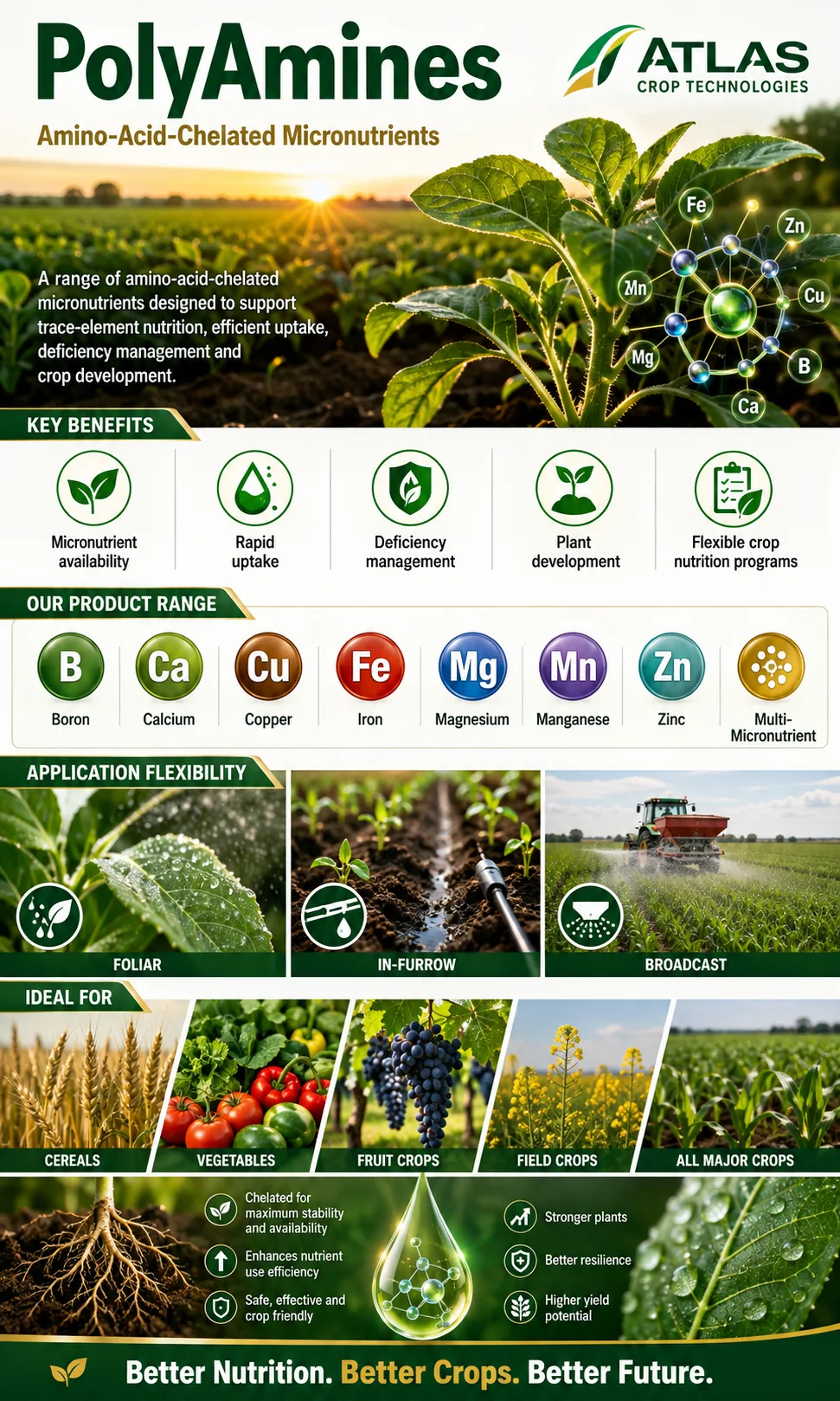
A versatile range of amino-acid-chelated micronutrients designed to help prevent or correct trace-element deficiencies while supporting efficient nutrient uptake, plant development and practical crop-nutrition programs.
PolyAmines combine essential mineral nutrients with amino-acid-based chelation technology. The objective is to keep micronutrients in an appropriate form for delivery to the crop and enable flexible use in foliar, broadcast and in-furrow nutrition programs, subject to the approved label for each formulation.
Individual PolyAmine formulations, nutrient concentrations, application rates, crops, claims and registration vary by market. Always use the current locally approved label.
Micronutrient nutrition engineered for efficient delivery
Crops require micronutrients in smaller quantities than nitrogen, phosphorus or potassium, but those smaller quantities should not be confused with lesser importance. Essential trace elements support enzyme systems, photosynthesis, cell development, reproductive processes, chlorophyll formation and numerous metabolic pathways.
A crop may therefore suffer meaningful physiological or yield limitations when one essential micronutrient becomes unavailable, even when the field has sufficient supplies of macronutrients.
PolyAmines are designed as a family of amino-acid-chelated micronutrient products that can be selected according to the nutrient deficiency, crop stage and application strategy.
Manufacturer information describes the range as intended to prevent or correct trace-element deficiencies at different stages of plant growth while maintaining nutrients in an appropriate form until they can be utilised by the crop.
PolyAmines profile
Small quantities. Essential functions.
Balanced crop nutrition depends on supplying every essential nutrient in the quantity and form required by the crop.
Enzyme activity
Several micronutrients act as structural components, cofactors or activators of plant enzymes. A deficiency can therefore interrupt multiple biochemical reactions even when the nutrient is needed only in relatively small amounts.
Energy capture
Iron, magnesium, manganese and other mineral nutrients participate directly or indirectly in chlorophyll formation, photosynthetic reactions and plant energy metabolism.
Developing tissues
Boron, calcium, zinc and other nutrients contribute to the development of new tissues, cell structures, growing points and reproductive organs.
Crop development
Adequate mineral nutrition supports the physiological processes required for normal crop growth, flowering, fruit or seed development and harvest quality.
Why chelate a micronutrient?
Mineral nutrients can interact with other chemical components in water, soil, fertiliser solutions or spray mixtures. Depending on nutrient form and environmental chemistry, those interactions can reduce solubility or availability.
Chelation uses an organic molecule to associate with a mineral ion. The objective is to protect that nutrient from undesirable interactions long enough to improve delivery into the plant or root environment.
PolyAmines use amino-acid-based chelation rather than relying solely on an uncomplexed mineral salt.
Amino-acid-associated nutrient delivery
Manufacturer information describes PolyAmines as amino-acid-chelated micronutrients whose binding characteristics are designed to keep nutrients in an appropriate form until utilised by the plant.
The manufacturer also positions these binding characteristics as allowing micronutrients to be combined with macronutrient programs for practical plant absorption.
Different chelating or complexing agents have different chemical behaviour. Product performance should therefore be assessed from the actual formulation, nutrient concentration, application method and field conditions rather than from the word "chelated" alone.
Designed for practical micronutrient programs
Micronutrient availability
Amino-acid chelation is intended to maintain mineral nutrients in a useful form during delivery to the crop.
Rapid plant uptake
Manufacturer information describes PolyAmines as containing specific biological molecules intended to enhance rapid nutrient uptake by plants.
Longer-term nutrient uptake
The product range is also positioned to promote sustained nutrient uptake rather than providing only a short-lived nutritional event.
Low-rate efficiency
Manufacturer information describes the range as effective at relatively low application rates. Actual rates depend on crop, plant size, deficiency severity and individual formulation.
Program flexibility
Foliar, broadcast and row or in-furrow use enables PolyAmines to fit several crop-nutrition strategies according to local labels.
Tank-mix potential
Manufacturer information states that PolyAmines are compatible with most crop inputs, allowing micronutrient supplementation to be integrated into existing management programs where labels permit.
Select the nutrient according to the agronomic requirement
Current manufacturer information identifies several single- nutrient and multi-micronutrient PolyAmine formulations. Availability differs by market.
PolyAmine Boron
Designed to prevent or correct boron deficiency. Boron is associated with cell-wall development, growing tissues, reproductive development and movement of carbohydrates within the plant.
PolyAmine Calcium
Designed to prevent or correct calcium deficiency. Calcium plays structural roles in plant cell walls and membranes and is particularly important in actively developing tissues.
PolyAmine Copper
Designed to prevent or correct copper deficiency. Copper participates in enzyme systems, electron transfer, lignification and several plant metabolic processes.
PolyAmine Iron
Designed to prevent or correct iron deficiency. Iron supports chlorophyll-related metabolism, electron transport and numerous enzymatic processes.
PolyAmine Magnesium
Designed to prevent or correct magnesium deficiency. Magnesium is the central atom in the chlorophyll molecule and contributes to photosynthesis, enzyme activation and energy metabolism.
PolyAmine Manganese
Designed to prevent or correct manganese deficiency. Manganese contributes to photosynthesis, enzyme activation and normal plant metabolism.
PolyAmine Zinc
Designed to prevent or correct zinc deficiency. Zinc contributes to enzyme activity, protein synthesis, hormone metabolism and normal plant development.
PolyAmine Micro-Pak
A multi-micronutrient formulation positioned to prevent or correct trace-element deficiencies where more than one micronutrient may require nutritional support.
Other PolyAmine formulations
Manufacturer materials also identify formulations such as PolyAmine BMZ and PolyAmine MultiMineral in certain markets. Product composition and registration should be confirmed locally.
Boron
Boron is required in very small amounts but performs important roles in cell-wall structure, growing-point development, flowering, reproductive development and movement of sugars within the plant.
Boron management requires particular care because the concentration range between deficiency and excessive application can be relatively narrow for some crops.
PolyAmine Boron is positioned by the manufacturer to prevent or correct boron deficiency and is designed for foliar, row or broadcast use according to the approved label.
When boron deserves attention
Do not diagnose or correct boron deficiency solely from visual symptoms. Excess boron can injure sensitive crops. Use soil or tissue analysis and a locally appropriate recommendation.
Calcium
Calcium contributes to cell-wall structure, membrane stability and development of new tissues. Because calcium movement within many plants is strongly associated with transpiration and xylem flow, rapidly developing tissues can experience inadequate calcium supply even where total calcium in the soil is not exceptionally low.
PolyAmine Calcium is designed by the manufacturer to prevent or correct calcium deficiency and can be used in crop nutrition programs according to current registered directions.
Calcium management is more than soil calcium
Plant calcium status can be influenced by root activity, moisture, transpiration, salinity, competing cations, growth rate and the ability of calcium to reach the developing tissue.
Foliar calcium should therefore be viewed as a targeted nutritional tool rather than an automatic substitute for correcting root-zone, irrigation or broader mineral-balance problems.
Iron
Iron participates in electron-transfer processes, enzyme systems and chlorophyll-related plant metabolism. Because iron is relatively immobile within the plant, deficiency often becomes visible first in younger leaves.
Soil may contain substantial total iron while the plant still experiences deficiency because chemical conditions restrict its availability.
PolyAmine Iron is positioned to prevent or correct iron deficiency through label-approved foliar, row or broadcast applications.
Manganese
Manganese contributes to enzyme systems and photosynthetic processes. Its availability can be strongly influenced by soil pH, aeration, organic matter, soil chemistry and environmental conditions.
PolyAmine Manganese is positioned within the current manufacturer portfolio for targeted correction or prevention of manganese deficiency.
Zinc, copper and magnesium
Zinc
Zinc supports numerous enzyme systems and contributes to normal plant growth, protein metabolism and regulation of plant-growth processes.
Deficiency risk and response vary with crop, soil pH, phosphorus status, soil temperature, organic matter and other factors.
Copper
Copper is required for several enzyme reactions and contributes to lignification and plant metabolic processes.
Copper should be applied according to diagnosis because excessive application can create crop or soil-management concerns.
Magnesium
Magnesium occupies the central position in the chlorophyll molecule and is therefore closely linked with photosynthesis.
It also contributes to enzyme activation, energy transfer and nutrient metabolism within the plant.
Diagnose first, then select the micronutrient
An effective micronutrient program should solve an identified nutritional limitation rather than add trace elements without agronomic justification.
Soil analysis
Soil testing can provide useful information about nutrient concentration, pH and soil chemistry. Interpretation should use methods and critical values appropriate to the crop and region.
Tissue analysis
Plant-tissue testing can help assess the nutrient status of the crop itself and may be particularly valuable when soil nutrient availability does not correspond closely with total soil content.
Visual symptoms
Chlorosis, deformation, reduced growth and other symptoms can provide diagnostic clues, but similar symptoms may result from several nutrient, root, disease or environmental problems.
Field history
Previous crop response, soil type, irrigation water, pH, fertility practices and recurring deficiency patterns can help establish whether micronutrient limitation is likely.
Root-zone conditions
Compaction, waterlogging, drought, salinity and poor root health can reduce nutrient acquisition even when soil analysis shows an apparently adequate nutrient supply.
Response strips
Where practical, untreated comparisons or field strips can help determine whether an observed crop response is associated with the micronutrient treatment.
Why a nutrient can be present but unavailable
Soil pH
Soil reaction strongly influences the chemical form and availability of many micronutrients. A nutrient may be present in the soil yet poorly available to roots.
Moisture
Both drought and saturated soil can impair root activity and nutrient movement toward the root surface.
Temperature
Cold soils can reduce root growth and biological activity, limiting nutrient acquisition during early crop development.
Root health
Compaction, disease, insects, salinity or physical root damage can reduce the crop's ability to explore soil and absorb nutrients.
Nutrient interactions
Excess or deficiency of one mineral can affect uptake or physiological use of another. Balanced nutrition is therefore preferable to managing individual nutrients in isolation.
Soil chemistry
Carbonates, oxides, organic matter and other soil components can influence micronutrient solubility, retention and availability.
Multiple routes for targeted micronutrient delivery
Foliar application
Foliar nutrition delivers the micronutrient directly to above- ground plant surfaces and can provide a targeted route for correcting or preventing a diagnosed nutrient limitation.
Crop stage, leaf area, spray volume, weather and deficiency severity should all be considered when determining a foliar strategy.
Row or in-furrow application
Placement near the developing root system can position micronutrients in the early root zone when crop demand and root exploration are beginning.
Seed safety, concentration, fertiliser compatibility and placement requirements must follow the product and crop labels.
Broadcast application
Broadcast use can integrate PolyAmine formulations into broader nutrient-management programs where the specific formulation and crop label allow this application route.
Manufacturer information states that application rate depends on the crop, stage of growth and severity of deficiency. Maximum rates listed on product labels may correspond to mature plants, with proportionally reduced rates required for smaller plants. Always follow the current product label.
Getting more from a foliar application
Foliar nutrition can provide a direct route for micronutrient delivery, but spray performance is influenced by more than the nutrient source alone.
Effective application depends on the crop, leaf surface, growth stage, water quality, spray concentration, environmental conditions, coverage and compatibility with other materials in the tank.
Before spraying
Designed to fit practical crop programs
Manufacturer information describes PolyAmines as compatible with most other crop inputs and states that their binding characteristics allow micronutrients to be mixed with macronutrients.
This gives growers and advisers flexibility to incorporate targeted micronutrient nutrition into existing spray or fertiliser operations where labels permit.
"Compatible with most inputs" should not be interpreted as universal compatibility. Water chemistry, concentration, pH, fertiliser salts, pesticide formulation and mixing order can affect the physical or chemical behaviour of a tank mixture.
Compatibility questions
Nutrition and plant stress
Healthy mineral nutrition supports the metabolic systems plants use during both favourable and challenging growing conditions.
A micronutrient product should not be described as eliminating drought, heat, salinity, disease or other stresses. Instead, adequate nutrient status helps avoid the additional physiological limitation created by a nutrient deficiency.
PolyAmines can therefore be considered within broader crop programs intended to maintain nutritional balance during important stages of plant development.
Correct the limiting factor
If poor crop performance is caused by compaction, root disease, drought, salinity, waterlogging or another non-nutritional problem, applying additional micronutrient may not resolve the underlying limitation.
Micronutrients perform best when they address a genuine crop- nutrition requirement. Diagnose the production constraint before selecting the treatment.
Broad relevance across agricultural production
Manufacturer crop information positions PolyAmine micronutrients across multiple field, forage and specialty-crop programs. Registered crops vary by formulation and country.
Field crops
Micronutrient strategies may be used where soil conditions, tissue analysis, crop demand or field history indicate a trace- element limitation.
Vegetable crops
Intensive vegetable systems may require close monitoring of micronutrient balance throughout rapid vegetative and reproductive growth.
Orchards
Permanent crops can benefit from season-long nutrient monitoring, including targeted correction of diagnosed micronutrient limitations.
Grapes
Grapevine nutrition programs frequently monitor micronutrients such as zinc and boron in addition to the major nutrients, according to regional conditions and production objectives.
Berries
Micronutrients can influence berry crop growth and reproductive development, but over-application can also be harmful. Testing and crop-specific recommendations are important.
Tree nuts
Orchard nutrient programs may use foliar and soil diagnostics to identify when targeted micronutrient supplementation is justified.
Potatoes
PolyAmine micronutrients are included by the manufacturer among crop-nutrition options for potato production, subject to local product registration.
Forage crops
Micronutrient nutrition should be based on testing and crop need, particularly because excessive application of certain trace elements can be undesirable.
Apply according to crop demand and diagnosis
Early establishment
Early crop development can be sensitive to nutrient availability, especially where cold soil, limited rooting or other conditions temporarily restrict nutrient acquisition.
Rapid canopy growth
High growth rates increase nutrient demand and can expose a marginal nutrient supply that was not obvious during earlier stages.
Flowering and reproductive development
Certain nutrients have important functions in reproductive development. Targeted correction should be based on crop-specific recommendations and confirmed need.
Confirmed deficiency
Where tissue analysis, field history or other diagnostic evidence confirms a deficiency, a targeted PolyAmine formulation can be incorporated into the nutritional program according to label.
Information that helps us select the right formulation
Supplying detailed crop and analytical information allows a more useful discussion than simply requesting a general micronutrient.
Crop and variety
Identify the crop, variety or cultivar and production system where relevant.
Country and region
Location helps determine registration, product availability and the soil and environmental context of the recommendation.
Soil analysis
Include recent soil pH, organic matter, nutrient results and any locally relevant soil characteristics.
Tissue analysis
Provide tissue results, plant stage and sampling method when available.
Symptoms
Describe where symptoms occur, which leaves are affected, when the issue appeared and whether the pattern is uniform or field-specific.
Current fertiliser program
List major fertilisers, micronutrients and other nutritional products already being used.
Application route
Indicate whether foliar, broadcast, in-furrow or another label-approved application strategy is preferred.
Tank-mix partners
Include fertilisers, pesticides, biostimulants and adjuvants that may be applied at the same time.
Commercial requirement
For distribution enquiries, include expected volume, market, application segment, customer type and timing requirement.
PolyAmines product-family profile
Avoid common program mistakes
Treating symptoms without diagnosis
Similar chlorosis or poor growth can result from different nutrient deficiencies, root damage, disease, herbicide injury, salinity or environmental stress.
Assuming more is better
Micronutrients are required in comparatively small amounts. Excessive application can be wasteful and may damage sensitive crops.
Ignoring pH
Soil and spray-water pH can influence nutrient availability, chemistry and tank-mix performance.
Ignoring root limitations
Applying additional nutrition may not solve a nutrient-uptake problem caused primarily by compaction, disease or poor soil moisture.
Assuming universal tank compatibility
General compatibility statements should never replace checking the labels and chemistry of the specific mixture being prepared.
Using rates from another market
Formulations and registrations differ. Application rates must come from the current local product label rather than a foreign label or internet source.
Explore related technologies
Integrate micronutrient technology with broader nutrient- efficiency, biological and crop-development programs according to crop requirements and local registration.
Pre-Vail®
A clay-based pre-inoculant for selected legumes, developed to support early root development, nodulation and seedling vigor.
View Product → InoculantPreside Ultra®
A soybean inoculant developed to support early nodulation, root development and efficient nitrogen acquisition.
View Product → FoliarprimacyALPHA®
A foliar nutrient and biostimulant technology intended to support nutrient assimilation, crop quality and reproductive performance.
View Product →Build a targeted micronutrient program
Tell us your crop, country, soil and tissue results, target nutrient, application method and existing fertiliser program. Atlas Crop Technologies can help identify the most relevant PolyAmine formulation and route your enquiry to the appropriate technical or commercial contact.
Frequently Asked Questions
These answers provide general agronomic and product-family information. Always use the current approved label for the exact PolyAmine formulation in your market.
PolyAmines are a family of amino-acid-chelated crop-nutrition products designed to prevent or correct micronutrient deficiencies and support efficient trace-element uptake and plant development.
Micronutrients are required in comparatively small quantities, but they participate in essential processes including enzyme activity, photosynthesis, chlorophyll-related metabolism, cell development and reproductive growth. A shortage of one essential nutrient can therefore limit crop performance.
Chelation associates a mineral ion with an organic ligand. In PolyAmines, manufacturer information describes amino-acid-based chelation intended to help maintain the micronutrient in a useful form until it can be taken up or utilised by the plant.
Current manufacturer information lists formulations for boron, calcium, copper, iron, magnesium, manganese and zinc, plus multi-micronutrient products such as Micro-Pak and other market-specific blends.
PolyAmine Boron is intended to prevent or correct boron deficiency. Boron contributes to cell-wall development, growing tissues and reproductive processes. Because excessive boron can injure sensitive crops, application should be based on diagnosis and the current crop label.
PolyAmine Calcium is intended to prevent or correct calcium deficiency. Calcium contributes to cell-wall structure, membrane stability and development of actively growing tissues.
PolyAmine Copper is intended to prevent or correct copper deficiency. Copper participates in multiple enzyme systems and physiological processes. Apply only according to crop need and current registered directions.
PolyAmine Iron is intended to prevent or correct iron deficiency. Iron contributes to chlorophyll-related metabolism, electron transport and enzyme systems. Iron deficiency can sometimes occur even in soils containing substantial total iron when soil chemistry limits availability.
PolyAmine Magnesium is intended to prevent or correct magnesium deficiency. Magnesium forms the central part of the chlorophyll molecule and contributes to photosynthesis, enzyme activation and plant energy metabolism.
PolyAmine Manganese is intended to prevent or correct manganese deficiency. Manganese contributes to enzyme and photosynthetic processes and its availability can be strongly affected by soil conditions.
PolyAmine Zinc is intended to prevent or correct zinc deficiency. Zinc contributes to enzyme function, protein metabolism, growth regulation and normal crop development.
PolyAmine Micro-Pak is a multi-micronutrient formulation intended for situations where broader trace-element supplementation is appropriate. Its exact guaranteed analysis and registered crops should be confirmed from the current local label.
Current manufacturer information describes foliar, row or in-furrow and broadcast use across the product family. Not every formulation necessarily carries every application route, so use the current local label.
Yes, several PolyAmine formulations are positioned for foliar application. Exact rates depend on the product, crop, plant size, growth stage and deficiency severity.
The PolyAmine product family is identified by the manufacturer for row or in-furrow use where the individual formulation label permits it. Placement, concentration and compatibility should follow crop-specific directions.
Use the current locally approved label for the exact PolyAmine product. Manufacturer guidance states that rates depend on the crop, plant growth stage and severity of nutrient deficiency. Rates intended for mature plants may need to be reduced proportionally for smaller plants where the label instructs.
Manufacturer information states that the products' binding characteristics allow PolyAmine micronutrients to be mixed with macronutrients for plant absorption. Always verify the exact products, water quality and labels before preparing the mixture.
Manufacturer information describes PolyAmines as compatible with most crop inputs. This does not guarantee compatibility with every pesticide, fertiliser, biological or adjuvant. Follow all labels and perform a compatibility check where appropriate.
A small-scale compatibility test can be useful where a proposed tank mixture has not previously been used, provided all labels permit the mixture. A physical compatibility test does not by itself confirm crop safety or biological compatibility.
Combine soil analysis, tissue analysis, crop symptoms, field history, soil pH, root health and local agronomic knowledge. Visual symptoms alone can be misleading because several deficiencies and stresses may look similar.
Yes. Essential micronutrients are required within an appropriate concentration range, and excessive application can injure crops or create undesirable soil accumulation. Apply according to crop need and current recommendations.
Not always. Soil tests provide valuable information, but nutrient acquisition is also influenced by soil chemistry, moisture, temperature, root development, microbial processes and crop physiology. Tissue analysis can provide useful complementary information.
PolyAmines are crop-nutrition products and should not be treated as substitutes for correcting drought, disease, compaction, waterlogging or other underlying stresses. Adequate nutrient status can prevent an additional nutritional limitation, but the primary stress still requires appropriate management.
Manufacturer information describes the range as suitable for use on sensitive crops without phytotoxicity concern when applied as directed. Crop safety still depends on using the correct product, rate, growth stage and tank-mix combination according to label.
No. Current manufacturer information shows that availability differs by formulation and country. Registration, guaranteed analysis, crop claims and application rates can therefore vary.
Include your country and region, crop, growth stage, soil test, tissue analysis if available, visible symptoms, soil pH, irrigation-water information where relevant, current fertiliser program, target nutrient and preferred application method.
Use the contact form on this page or email contact@fertilizercoatingproducts.com with your country, company, intended market, target PolyAmine formulation, approximate requirement and commercial application.
This page provides general product-family and agronomic information. PolyAmine formulation, guaranteed nutrient analysis, nutrient concentration, chelating or complexing constituents, registered crops, application rates, permitted application routes, tank-mix directions, pack sizes, claims and commercial availability can differ between countries.
Micronutrient deficiencies should be diagnosed using appropriate agronomic evidence. Excessive micronutrient application can damage sensitive crops and does not necessarily correct production problems caused by root disease, soil compaction, drought, waterlogging, salinity or other non-nutritional factors.
Always read and follow the current approved product label and local fertiliser regulations. Consult a qualified crop adviser or Atlas Crop Technologies representative where a crop-specific recommendation, compatibility assessment or local registration confirmation is required.