Plant Development
Biostimulant seed treatments are positioned during the earliest crop stages, where root and shoot development begin to establish the plant's future resource-capture capacity.
Trademark Notice: All products featured on this website are registered trademarks of Verdesian Life Sciences.
A biostimulant seed treatment developed to promote rapid seedling development, stronger root growth, efficient nutrient use, early nitrogen utilization and improved resilience during crop establishment.
Take Off® PGA contains two biostimulants designed to support strong young plants from the first stages of life. The technology is positioned at the seed stage, before later fertiliser and foliar programs can begin influencing the developing crop.
Product registration, approved crops, rates, formulations, claims, compatibility directions and pack sizes can differ by market. Always follow the current approved local label.
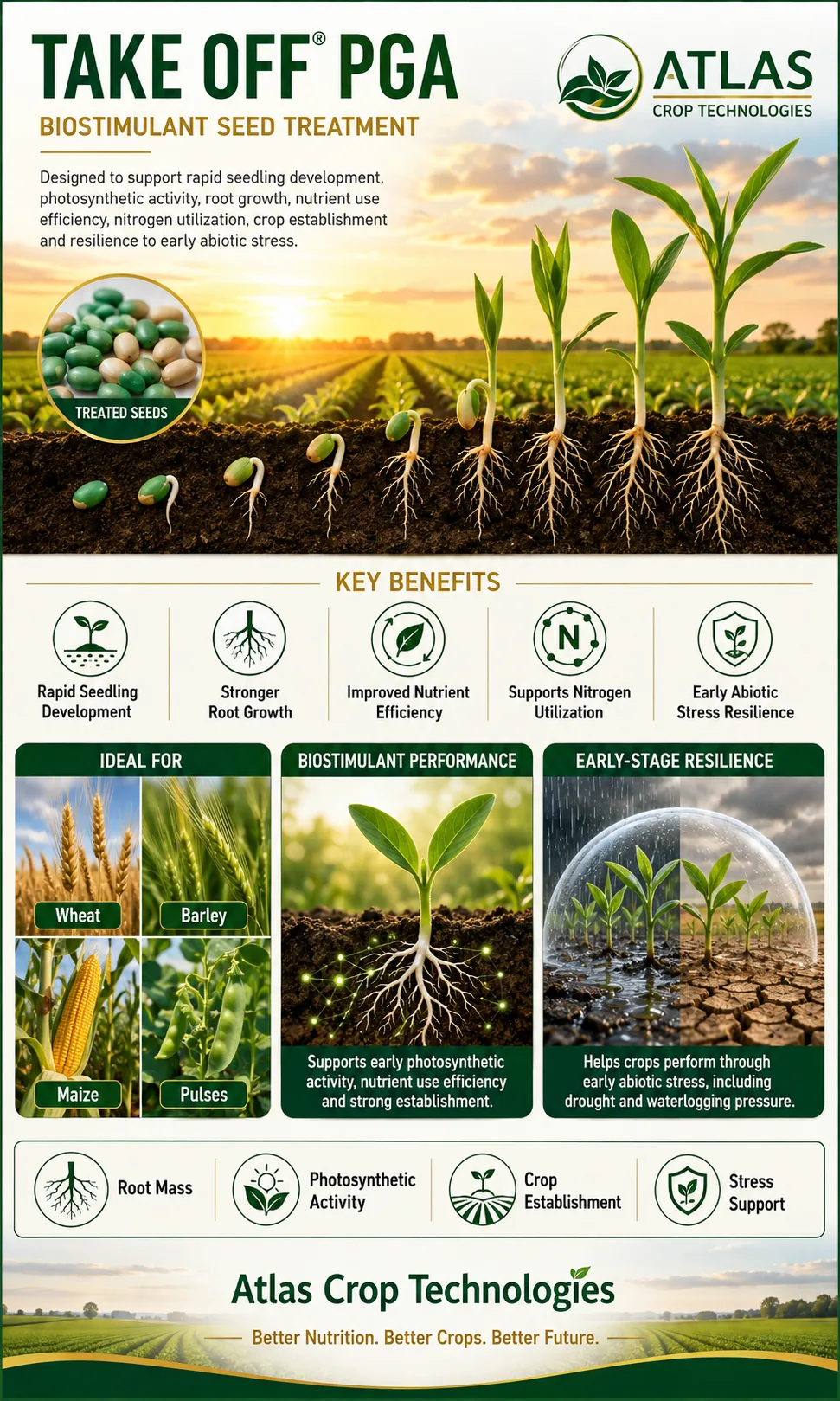
Early crop establishment is a short but highly active phase in which germination, root initiation, shoot development, photosynthetic activity and nutrient acquisition begin to shape the young plant.
Take Off® PGA is a seed-applied biostimulant technology designed to influence this establishment phase before later fertiliser or foliar applications can contribute to crop management. Published Verdesian information describes the product as containing two robust biostimulants that promote the growth of strong young plants.
The technology is positioned around improved photosynthetic activity, increased root mass, improved nutrient use efficiency and greater ability to cope with stress factors including drought and waterlogging.
Take Off® PGA is also associated with improved early nitrogen utilization. Published product information describes accelerated carbon dioxide fixation within the plant as part of the mechanism supporting faster nitrogen uptake and stronger root and shoot establishment.
Biostimulant technologies are generally used to influence plant physiological processes, nutrient utilization, establishment or stress response. They should be considered separately from the fertiliser required to supply the crop's essential nutrients.
Biostimulant seed treatments are positioned during the earliest crop stages, where root and shoot development begin to establish the plant's future resource-capture capacity.
A biostimulant may be used to support how plants acquire, process or utilize nutrients already present within the crop nutrition system.
Take Off® PGA is specifically positioned around photosynthetic activity and carbon dioxide fixation during early plant development.
Published product information describes greater resilience to early environmental stresses including drought and waterlogging.
The crop still requires an agronomically appropriate nutrient supply. Nitrogen, phosphorus, potassium, sulphur, micronutrients and other essential elements should be managed according to crop demand, soil fertility, expected yield, environmental conditions and local recommendations.
Take Off® PGA is positioned around plant function and early development, helping the seedling establish and make effective use of the resources available within the wider crop system.
The young plant moves rapidly from dependence on seed reserves toward active photosynthesis and nutrient acquisition. Take Off® PGA is designed to operate during this transition.
Germination activates the embryo and begins development of the root and shoot systems that will form the young crop.
Early roots begin exploring the surrounding soil for water and nutrients as seed reserves are progressively consumed.
Developing shoots and leaves move the crop toward active photosynthesis and greater independence from stored seed energy.
Strong root and shoot development provides the structural and physiological platform for continued crop growth.
Photosynthesis allows the plant to capture carbon dioxide and convert light energy into carbon compounds used to build new tissue.
Published Verdesian information describes Take Off® PGA as optimizing and accelerating carbon dioxide fixation during plant development.
As leaf area and photosynthetic activity increase, the young crop gains greater capacity to generate the energy and carbon skeletons required for continued root and shoot growth.
Nitrogen is required for proteins, enzymes, chlorophyll and many other components involved in plant growth.
Published Take Off® PGA information connects accelerated carbon dioxide conversion with increased nitrogen uptake by the seedling and higher nitrogen utilization.
The objective is not to replace nitrogen fertiliser, but to support the developing crop as it begins acquiring and utilizing nutrition from the surrounding soil and fertiliser program.
Verdesian positions Take Off® PGA as acting from the seed-treatment stage, providing stimulation during the period before soil-applied fertiliser and later foliar inputs can exert their full influence on the developing crop.
Roots provide the physical interface between the crop and the soil environment. As root mass increases, the plant can explore a larger soil volume for available moisture and nutrients.
Increased root mass is one of the core agronomic effects described in published Take Off® PGA information.
Early root development is particularly important because young seedlings initially access only a relatively small volume of soil. Stronger early roots can help expand that resource-capture zone as crop demand increases.
Root growth expands the soil volume from which the crop may acquire nutrients and water.
Nutrient uptake must be connected with active plant metabolism for absorbed nutrients to contribute effectively to new plant growth.
Take Off® PGA is positioned around improving nutrient use efficiency, helping the early plant convert available resources into stronger growth.
Fertiliser decisions should continue to follow crop need, local nutrient recommendations and regulatory requirements. A biostimulant should not be used as justification for applying less or more fertiliser unless the specific crop program is supported by appropriate local agronomic evidence.
Published Take Off® PGA information describes increased crop resilience to environmental stresses including drought, waterlogging and adverse pH conditions. This positioning should be understood as support for plant resilience rather than protection from severe stress.
Young plants with small root systems can be particularly sensitive to moisture limitations. Increased root development can support access to a larger soil-water volume, although no treatment can eliminate the effects of severe drought.
Waterlogged soils can restrict oxygen availability around roots and disrupt normal plant and root metabolism. Published Verdesian information includes waterlogging among the stresses Take Off® PGA is positioned to help plants overcome.
Soil pH influences nutrient availability, root environment and soil chemistry. Published product information also references resilience where adverse pH conditions influence early crop growth.
Published Verdesian information states that Take Off® PGA has been evaluated through extensive trial and grower experience and has also been the subject of academic review.
The European product page reports experience with untreated-seed comparisons across cereals, maize and pulses and refers to more than 200 trials together with significant grower experience accumulated over approximately ten years.
Specific crop experience cited by Verdesian includes winter wheat, winter barley, spring barley, oats, maize and rye.
Trial results from one geography should not automatically be transferred to another. Crop response depends on genetics, environment, planting conditions, soil fertility, management and the exact locally registered product.
These examples reflect published product experience and do not establish registration in every country. Always verify the approved local crop list.
Winter wheat is specifically included among crops referenced in published Take Off® PGA trial and grower experience.
Published product information references experience with both winter barley and spring barley.
Oats and rye are also named in Verdesian's published European product experience.
Maize is specifically referenced in product trials and untreated-seed comparisons.
Published Verdesian information also describes improved effects in pulse crops compared with untreated seed.
Product registration and permitted crop uses can differ from product-development or trial experience. Confirm the current approved label before treatment.
Published Verdesian positioning highlights crop systems in which poor establishment or a period of restricted growth may be difficult for the plant to compensate for later.
In this context, Take Off® PGA is positioned around supporting early establishment and helping retain crop yield potential when early development is exposed to unfavourable conditions.
Yield is ultimately determined by many interacting factors across the entire season. Seed treatment should therefore be considered one component of a broader strategy involving seed quality, plant population, fertility, crop protection, water management and in-season agronomy.
Published European guidance states that Take Off® PGA can be applied through conventional seed-treatment equipment. Equipment should be clean, correctly calibrated and maintained in serviceable condition before use.
Verify that the exact Take Off® PGA formulation is approved for the intended crop, country and application.
Ensure the seed treater is clean, correctly calibrated and capable of delivering the specified treatment volume uniformly.
Identify all crop-protection, nutritional, polymer, biological and other seed-treatment products included in the treatment mix.
Use approved product rates, liquid volumes, mixing sequence and calibrated equipment to achieve consistent treatment across the seed lot.
The following information summarizes published European Verdesian guidance and does not replace the approved label in the country where the product will be used.
Published European product guidance lists an application rate of 1 litre of product per tonne of seed.
European guidance states that the 1 litre of Take Off® PGA should be applied within a minimum total liquid solution of 2 litres per tonne of seed.
Published European Verdesian information describes Take Off® PGA as compatible with most agrochemical and plant-nutrition seed treatments.
Compatibility should nevertheless be evaluated using the exact formulations planned for the commercial seed-treatment recipe. Products that are individually suitable for seed treatment may still interact physically or chemically when combined in concentrated form.
Total slurry volume, water quality, temperature, formulation type, polymers, biological products and treatment equipment can all influence practical compatibility.
Published European mixing instruction: when Take Off® PGA is used in a mixture with other products, avoid direct contact between concentrates during mixing and add Take Off® PGA as the final product.
Published European guidance specifies adding Take Off® PGA as the final product when it is included in a tank mix of other seed-treatment products.
This guidance also advises preventing direct contact between concentrated products during the preparation process.
European product information states that where the 2-litre liquid solution is a tank mix of seed treatments, Take Off® PGA should be added last and the prepared solution applied immediately to the seed.
Always check the current local label because treatment instructions can be revised or vary between registrations.
| Attribute | Published reference information |
|---|---|
| Product category | Biostimulant seed treatment. |
| Biostimulant positioning | Contains two robust biostimulants designed to promote strong young plant development. |
| Photosynthetic activity | Published product information describes improved photosynthetic activity and accelerated carbon dioxide fixation. |
| Root development | Increased root mass is listed among the principal agronomic effects. |
| Nutrient efficiency | Improved nutrient use efficiency and higher nitrogen utilization are included in published positioning. |
| Stress positioning | Published information references improved ability to overcome drought, waterlogging and adverse-pH stress factors. |
| Crop experience | Cereals, maize and pulses, with specific experience reported in winter wheat, winter barley, spring barley, oats, maize and rye. |
| European reference rate | 1 litre of product per tonne of seed. |
| European reference liquid volume | Minimum 2 litres total liquid per tonne of seed. |
| Application equipment | Published guidance states the product can be applied through conventional seed-treatment equipment. |
| Compatibility | Described as compatible with most agrochemical and plant-nutrition seed treatments, subject to correct mixing and local directions. |
| Mixing sequence | Published European guidance states that Take Off® PGA should be added as the final product in a multi-product treatment mixture. |
| European reference pack sizes | 25 litres and 1,000 litres. |
These details summarize published European Verdesian information. Registration, formulation, packaging, claims and approved directions may differ by market.
Biostimulant support is positioned directly at the beginning of crop development, before planting.
The crop's macronutrient and micronutrient requirements should continue to be supplied through appropriate soil, fertiliser and irrigation programs.
Later foliar nutrition, crop protection, irrigation and agronomic management can continue supporting the crop after establishment.
Verdesian's European information notes that Take Off® PGA establishment can be further supported by following nutrition and crop-protection programs. Exact product combinations should always be selected according to local registration, crop need and professional agronomic guidance.
Where the production system benefits from strong early root and shoot development and rapid progression toward an established crop.
Where early soil exploration for moisture and nutrients is an important component of the agronomic strategy.
Where the crop-management strategy is focused not only on nutrient application but also on effective plant uptake and utilization.
Where establishment may be exposed to variable moisture, waterlogging, drought risk or other environmental stresses.
Where poor early establishment or a period of restricted growth may be difficult for the crop to compensate for later in the season.
Where seed is commercially or professionally treated and Take Off® PGA can be evaluated as part of an integrated treatment recipe.
Seed treatments cannot correct poor genetic purity, severely damaged seed or fundamentally inadequate germination capacity.
Appropriate planting depth, seed-to-soil contact and seedbed preparation remain essential for uniform emergence.
Biostimulants do not remove the need for an appropriate macro- and micronutrient fertility program.
Irrigation, drainage and soil-water management can strongly influence establishment and crop response.
A biostimulant seed treatment should not be assumed to replace fungicide, insecticide or other crop-protection measures required for local risk.
Compare emergence, crop uniformity, rooting and establishment performance where practical to understand how the complete program performs locally.
Discuss crop establishment objectives, early-season stress risk, nutrient programs and the role of biostimulant seed treatment.
Review treatment equipment, compatibility, slurry volume, mixing sequence, packaging and commercial workflow integration.
Explore country registration, product positioning, technical support, portfolio fit and commercial supply opportunities.
Evaluate Take Off® PGA as part of integrated nutrient-use efficiency, establishment and crop-resilience programs.
Providing relevant crop and treatment details helps Atlas Crop Technologies route your enquiry to the appropriate technical or regional contact.
Product choice should reflect crop requirements, nutrient program, application timing, local registration and the agronomic objectives of the complete production system.
A seed treatment designed to accelerate germination, emergence and early nitrogen uptake to support strong crop establishment.
View Product → BroadcastAn advanced nitrogen-management solution designed to improve nitrogen use efficiency and reduce nutrient loss.
View Product → Seed TreatmentA micronutrient seed treatment for cereals and pulses, designed to support early nutrient supply and crop establishment.
View Product →Tell us about your crop, seed-treatment program, establishment challenge, market or distribution requirement. Our team will route your enquiry to the appropriate regional contact.
The answers below provide general product and agronomic information. The current approved local label remains the authoritative source for legal product use.
Take Off® PGA is a biostimulant seed treatment from Verdesian Life Sciences. Published European product information describes it as containing two robust biostimulants designed to promote the growth of strong young plants.
Take Off® PGA is positioned at the seed-treatment stage to support rapid seedling development before later fertiliser and foliar products can fully influence the crop.
Published product information highlights improved photosynthetic activity, increased root mass, improved nutrient use efficiency and greater ability to cope with selected abiotic stresses.
A biostimulant seed treatment is applied to seed before planting with the objective of supporting plant physiological processes during early crop development.
Unlike a bulk fertiliser, a biostimulant is generally positioned around plant function, nutrient-use efficiency, establishment or stress response rather than supplying the crop's total nutrient requirement.
Published European Verdesian information describes Take Off® PGA as containing two robust biostimulants that promote the growth of strong young plants.
Published Verdesian information describes Take Off® PGA as further optimizing and accelerating carbon dioxide fixation in the plant.
This is associated with increased nitrogen uptake by the seedling and stronger root and shoot establishment.
Carbon dioxide fixation is part of the photosynthetic process through which plants incorporate atmospheric carbon dioxide into organic compounds used to support growth and metabolism.
Take Off® PGA is positioned around supporting this process during early plant development.
Improved photosynthetic activity is one of the agronomic effects highlighted in published European Take Off® PGA information.
Actual plant response depends on crop, environment and overall crop management.
Yes. Increased root mass is specifically included among the benefits described in published Verdesian product information.
Root growth is also influenced by soil structure, moisture, temperature, nutrient availability, crop genetics and other agronomic factors.
Roots allow the plant to explore soil for nutrients and water. A larger functioning root system can increase the volume of soil available to the crop as demand rises during establishment.
Improved nutrient use efficiency is one of the principal benefits highlighted in published European Take Off® PGA product information.
The technology should complement, rather than replace, an appropriate crop fertility program.
Published Verdesian material states that Take Off® PGA accelerates carbon dioxide fixation in the plant, which boosts and increases the rate of nitrogen uptake by the seedling.
Nitrogen utilization refers to how effectively the plant acquires and uses available nitrogen within its growth and metabolic processes.
Take Off® PGA is positioned around supporting this process during establishment rather than supplying the crop's full nitrogen requirement.
No. Take Off® PGA is a biostimulant seed treatment, not a replacement for the nitrogen fertiliser required by the crop.
Fertiliser rates should continue to follow crop demand, soil supply, expected yield, local recommendations and regulatory requirements.
Published Verdesian product information describes an improved ability to overcome stress factors including drought.
This should not be interpreted as protection from severe water shortage. Rooting depth, soil water availability, irrigation and weather remain major determinants of drought response.
Waterlogging is also specifically referenced among the stress factors in published European Take Off® PGA positioning.
Severe or prolonged flooding can still damage crops significantly, so drainage and field-water management remain important.
Published Verdesian information describes reduced environmental risk from adverse pH among the positioning associated with stronger early plants and higher nitrogen utilization.
The product does not correct soil pH itself. Soil amendment decisions should continue to be based on soil analysis and local agronomic guidance.
Published Verdesian information describes academic review and trial experience across cereals, maize and pulses.
Specific crop experience cited includes winter wheat, winter barley, spring barley, oats, maize and rye.
Crop registration can vary by market, so trial experience must not be treated as universal label approval.
Published European Verdesian information states that more than 200 trials, together with significant grower experience over approximately ten years, have demonstrated faster and better establishment across several crop types.
Local results can vary substantially with environment and management.
No agricultural input can guarantee a particular yield result. Take Off® PGA is positioned around establishment, root development, nutrient efficiency and stress resilience, but final yield is influenced by genetics, weather, soil, nutrition, pests, disease and season-long management.
Take Off® PGA is applied as a seed treatment before planting. Published European guidance states that it can be applied through conventional seed-treatment equipment.
Equipment should be clean, correctly calibrated and in good serviceable condition before application.
Published European Verdesian guidance lists a rate of 1 litre of Take Off® PGA per tonne of seed.
This is reference information only. Always use the rate stated on the current approved product label for your market.
Published European guidance states that the 1 litre product rate should be applied using a minimum total liquid volume of 2 litres per tonne of seed.
Treatment volume must also be appropriate for the seed-treatment equipment and the complete product recipe.
Published European guidance describes Take Off® PGA as compatible with most agrochemical and plant-nutrition seed treatments.
Compatibility still needs to be confirmed for the exact products and formulations planned for use.
Yes. Published European product guidance states that concentrates should not be allowed to contact one another directly during mixing and that Take Off® PGA should be added as the final product.
Published European guidance states that when Take Off® PGA is part of a 2-litre tank-mix solution, the product should be added last and the prepared mixture applied immediately to the seed.
Follow the latest local product directions because instructions can vary.
No. Take Off® PGA is positioned as a biostimulant seed treatment. It should not be assumed to replace fungicides, insecticides or other crop-protection products required to manage local pest and disease risks.
Compatibility with inoculants or other living biological products should be specifically confirmed because biological viability can be affected by other ingredients in the treatment recipe.
Follow technical guidance for all products involved.
Current published European Verdesian information lists 25-litre and 1,000-litre pack sizes for Take Off® PGA.
Commercial packaging and availability may vary by country.
No. Registration, formulation, approved crops, claims, application rates, compatibility directions and packaging can differ between markets.
Contact Atlas Crop Technologies for current market-specific information.
Include your country, crop, seed quantity, planting date, seed-treatment recipe, fertility program, relevant establishment or stress concerns and the technical objective you want to discuss.
Use the enquiry form on this page or email contact@fertilizercoatingproducts.com .
Include your company, country, crop or market, approximate product requirement and the nature of your commercial, trial or distribution enquiry.
Trademark Notice: All products featured on this website are registered trademarks of Verdesian Life Sciences.