AVAIL®
A phosphorus fertiliser enhancer designed for granular and liquid phosphate fertilisers to reduce phosphorus fixation, keep more applied P available for crop uptake and improve the agronomic return from phosphate fertiliser investment.
Verdesian positions AVAIL® around a highly negatively charged micro-environment surrounding phosphate fertiliser. By interacting with positively charged cations associated with phosphorus fixation, the technology is intended to preserve a larger plant-available phosphorus pool during critical periods of crop development.
Current European manufacturer treatment rates are 2.1 L per metric tonne of granular phosphate fertiliser and 5 L per 1,000 L of liquid tank mix. Always verify the current approved local AVAIL® label before treatment, sale or recommendation.
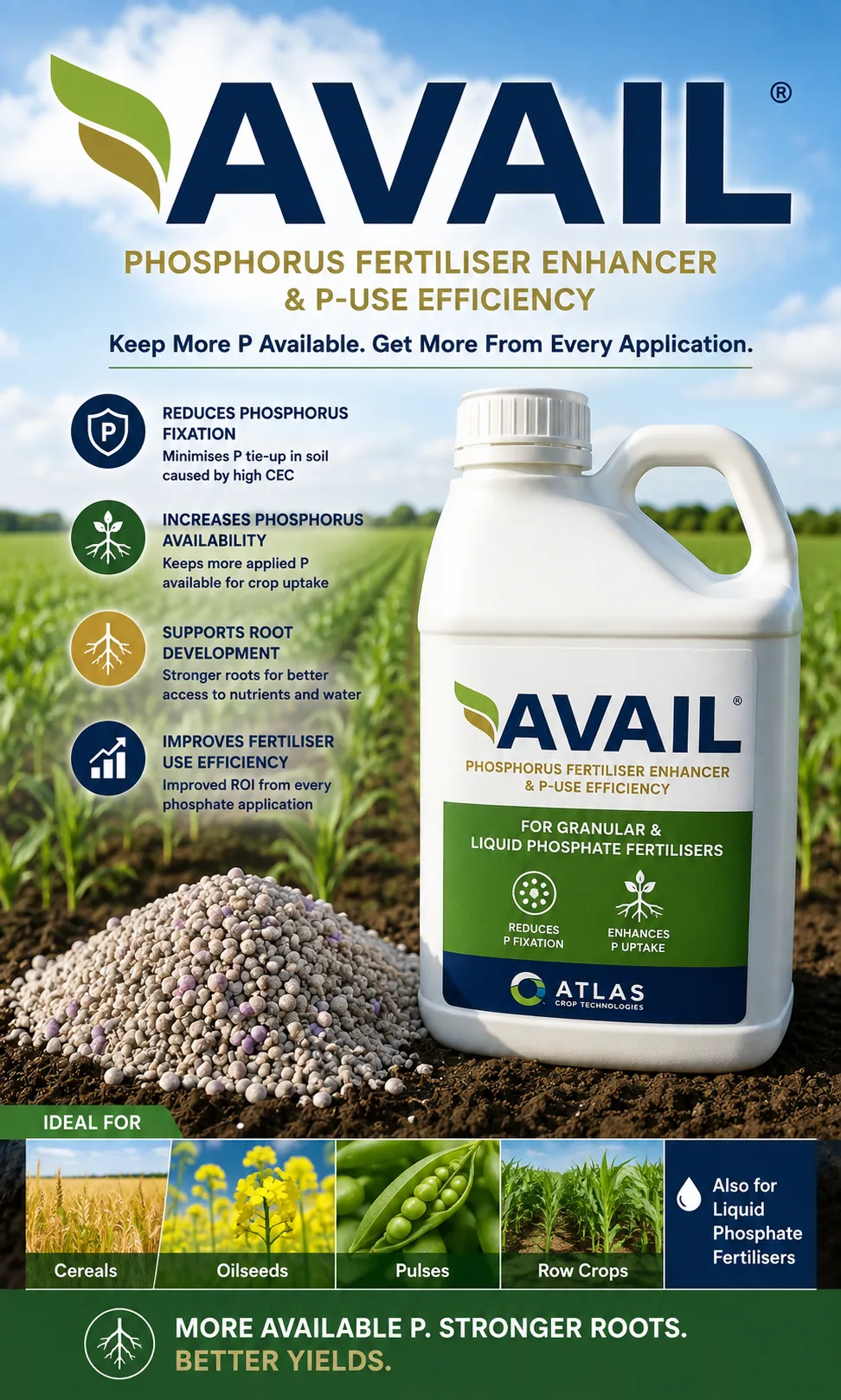
Protecting the efficiency of applied phosphate fertiliser
Phosphorus is essential to crop growth but can quickly undergo soil reactions that reduce the amount remaining in readily plant-available forms after fertiliser application.
AVAIL® is designed to improve the efficiency of that applied phosphorus rather than replace phosphorus fertiliser itself.
Current Verdesian Europe information positions the product for both granular and liquid phosphate fertilisers and states that treated fertiliser is then applied to the soil in the same way as untreated phosphate fertiliser.
AVAIL® at a glance
Why phosphorus matters to crop development
Energy transfer
Phosphorus is integral to ATP and related energy-transfer chemistry used throughout plant metabolism.
Root development
Adequate phosphorus is particularly important during establishment and early root-system expansion.
Cell division
Phosphorus is part of nucleic acids and is essential to rapidly growing tissues.
Membranes
Phospholipids are fundamental structural components of cell membranes.
Photosynthesis
Phosphorus participates in energy transfer and carbon metabolism associated with photosynthesis.
Reproductive growth
Phosphorus supports energy-intensive reproductive and yield-forming processes.
What is phosphorus fixation?
After soluble phosphate fertiliser dissolves, phosphate ions can react with soil minerals and positively charged cations.
These reactions can convert readily soluble phosphorus into less immediately plant-available forms.
Agronomists commonly describe this reduction in immediate phosphorus availability as phosphorus fixation or tie-up.
Fixed phosphorus is not necessarily permanently lost
Some fixed phosphorus can participate in slower soil-equilibrium and biological cycling processes over time. AVAIL® is designed to reduce fixation of newly applied phosphate fertiliser—not to remove every phosphorus-binding process in soil.
Iron and aluminium can restrict phosphate availability
In acidic mineral soils, soluble phosphate can become strongly associated with iron- and aluminium-containing mineral surfaces.
These reactions can reduce the concentration of phosphate remaining available in soil solution.
Evaluate
Calcium can reduce soluble phosphate availability
In calcareous and higher-pH soils, phosphate can react with calcium and progressively form less soluble calcium-phosphate compounds.
This is one reason phosphorus availability can remain constrained even where total soil phosphorus is substantial.
Evaluate
A highly negatively charged phosphate micro-environment
Verdesian describes AVAIL® as creating a highly negatively charged micro-environment around treated phosphate fertiliser.
The manufacturer positions those negative charges as interacting with positively charged cations that would otherwise contribute to phosphorus fixation.
The intended result is for more applied phosphate to remain available for crop uptake during the period when roots are actively developing.
1,800 meq / 100 g
This is manufacturer-described technology data and should not be confused with the native cation-exchange capacity of the entire soil.
Cations associated with phosphorus fixation
Calcium
Particularly relevant to phosphorus reactions in calcareous and alkaline soils.
Iron
Iron oxides and iron-containing surfaces can strongly adsorb phosphate in many acidic soils.
Aluminium
Aluminium compounds can also contribute to strong phosphate sorption under acidic conditions.
2.1 L AVAIL® per metric tonne
Current Verdesian Europe guidance states that AVAIL® for granular phosphate fertiliser should be evenly sprayed onto the granules at:
Uniform coating is important because AVAIL® is intended to function in the immediate micro-environment surrounding treated phosphate fertiliser.
Coat the phosphate fertiliser evenly
Granular AVAIL® calculation examples
Based on the current European manufacturer rate of 2.1 L per metric tonne.
1 tonne phosphate
2.1 L AVAIL®
10 tonnes phosphate
21 L AVAIL®
25 tonnes phosphate
52.5 L AVAIL®
100 tonnes phosphate
210 L AVAIL®
5 L AVAIL® per 1,000 L total tank mix
Current Verdesian Europe guidance lists AVAIL® for liquid phosphate fertiliser at:
AVAIL® concentration therefore needs to represent 0.5% of the total liquid mixture according to current manufacturer guidance.
Calculate against total final tank volume
Do not calculate 5 L per 1,000 L of only one component if the finished mixture has a different total volume.
Liquid AVAIL® calculation examples
500 L final mix
At 0.5%: 2.5 L AVAIL®
1,000 L final mix
At 0.5%: 5 L AVAIL®
5,000 L final mix
At 0.5%: 25 L AVAIL®
10,000 L final mix
At 0.5%: 50 L AVAIL®
Apply phosphate fertiliser using normal soil-application agronomy
Verdesian states that AVAIL®-treated granular and liquid phosphate fertilisers should be applied to the soil in the same manner as the corresponding untreated phosphate fertiliser.
AVAIL® changes the management of phosphate-fertiliser efficiency; it does not convert soil-applied phosphate fertiliser into a foliar treatment.
Broadcast & in-furrow
Exact permitted placement depends on the phosphate fertiliser, crop system and current local label.
Where AVAIL® can fit in phosphate-fertiliser programs
DAP
Diammonium phosphate is a widely used granular phosphate source and appears in Verdesian's European AVAIL trial material.
MAP
Monoammonium phosphate is another common granular phosphate source. Exact product treatment must follow current label guidance.
Phosphate blends
AVAIL® treatment should target the phosphate-fertiliser component in accordance with current treatment guidance.
Manufacturer positioning: any soil type
Current Verdesian Europe information states that AVAIL® is designed to reduce phosphate-fertiliser fixation in any soil type.
This broad positioning reflects the fact that phosphorus reactions occur in acidic, neutral and alkaline soils, although the dominant fixation chemistry changes with soil properties.
Response can still vary with
Where phosphate fertiliser is agronomically justified
Verdesian states that AVAIL® can be used with crops where phosphate fertiliser is deemed useful for plant growth and development according to best management practices.
This is a broad technical positioning rather than proof that every crop is legally registered in every country.
Market-specific use
Early phosphorus access supports root-system expansion
Verdesian lists more robust roots and stalks among AVAIL® benefits.
Phosphorus availability is particularly relevant during early growth, when the root system is small and its soil-exploration capacity is limited.
Better early P access can support faster establishment where phosphorus availability is otherwise constraining.
Strong roots improve access to
Cool soils can constrain phosphorus acquisition
Low soil temperature slows root growth and can reduce nutrient diffusion toward roots.
These conditions can make adequate placement and availability of starter phosphorus especially important in early-planted crops.
This is general agronomic context and not a separate manufacturer claim that AVAIL® eliminates cold stress.
Consider
AVAIL® is an efficiency tool—not a blanket P-rate reduction program
AVAIL® is designed to improve the availability of applied phosphate fertiliser.
Current manufacturer and historical research includes experiments with reduced phosphorus rates, but rate-reduction results should not be converted into one universal fertiliser recommendation.
Local agronomy
+23% agronomic efficiency of DAP
Verdesian's current European AVAIL® technical material cites a University of Athens trial from 2016.
The manufacturer reports that AVAIL® increased the agronomic efficiency of DAP fertiliser by:
A trial result, not a universal guarantee
The +23% figure should therefore be presented as the cited trial result rather than a guaranteed response for every AVAIL® application.
10 independent French reduced-P trials
Verdesian reports commissioning 10 independent trials in France to evaluate AVAIL® with reduced phosphorus inputs.
The cited standard farmer practice was:
25% lower P input · average +3.8% yield
Verdesian states that DAP treated with AVAIL® and used at a 25% lower phosphorus input produced:
versus the cited full-rate farmer-practice fertiliser treatment across those trials.
Local phosphorus rates must remain based on current soil-test interpretation, crop requirement, field history, legislation and qualified agronomic advice.
Up to 45% more phosphorus utilised / accessible
Verdesian's current global AVAIL® materials state that crops can utilise or access up to 45% more phosphorus with AVAIL® technology.
This is a manufacturer-reported maximum response and should not be represented as a guaranteed 45% increase in every soil or crop.
Field conditions
Standard AVAIL® and AVAIL® T5 are not interchangeable names
Verdesian currently markets AVAIL® T5 as a newer and improved phosphorus-use-efficiency technology.
T5-specific formulation, performance, handling and storage claims should remain attached to AVAIL® T5 unless the standard AVAIL® label explicitly supports the same statement.
Standard AVAIL®
Do not substitute AVAIL® T5 label directions for standard AVAIL®.
Start with soil and crop information
Soil-test phosphorus
Determine whether the field is deficient, responsive or already in a high-P category using locally appropriate soil tests.
Soil pH
Helps interpret whether iron/aluminium or calcium chemistry is more likely to dominate P reactions.
Crop removal
Harvested products remove phosphorus from the field and influence long-term nutrient budgets.
Field history
Previous fertiliser, manure and yield history provide important context.
Tissue analysis
Can help identify whether the crop is actually experiencing phosphorus deficiency.
Root inspection
Poor rooting can limit P acquisition even where soil P availability is adequate.
Diagnose before assuming phosphorus fixation is the only problem
Phosphorus deficiency can reduce early growth and root development.
Some crops may develop dark green or purplish pigmentation under phosphorus stress, although visual symptoms are not always specific.
Cold temperature, root damage and other stresses can produce similar crop appearances.
Objective information
AVAIL® complements—not replaces—good fertiliser placement
Broadcast
Useful where phosphate is incorporated or distributed broadly through the fertilised soil volume.
Band / starter
Concentrating phosphorus near developing roots can improve early access in some crop systems.
In-furrow
In-furrow phosphate strategies require attention to fertiliser salt load, seed safety and crop-specific label guidance.
AVAIL® does not remove fertiliser salt or ammonia risk
When phosphate fertilisers are placed close to seed, crop safety depends primarily on the fertiliser formulation, total salt load, nutrient rate, seedbed moisture and crop sensitivity.
Treating phosphate with AVAIL® does not automatically make an otherwise unsafe in-furrow fertiliser rate safe.
Seed-safe agronomy
Improving phosphorus efficiency can support environmental objectives
Phosphorus lost from agricultural land can contribute to enrichment of surface waters.
Increasing crop use of applied phosphorus is therefore relevant to both fertiliser economics and nutrient stewardship.
Verdesian positions AVAIL® as improving fertiliser efficiency and reducing the amount of phosphorus unnecessarily tied up in soil.
Core P-loss management
Dissolved and particulate phosphorus losses are different
Dissolved P
Phosphorus dissolved in runoff water can move directly from the field during water-loss events.
Particulate P
Phosphorus attached to eroded soil particles can leave the field with sediment.
Management implication
Efficient fertilisation must be combined with erosion and runoff management.
Country resources currently listed by Verdesian
France
Germany
Greece
Kenya
Romania
Turkey
United Kingdom
South Africa
946 L IBC
The current Verdesian Europe AVAIL® product page lists:
Approximate treatment capacity
At the current granular rate of 2.1 L/t, one 946 L IBC contains enough AVAIL® to treat approximately:
Arithmetic illustration only; allow for equipment hold-up, residual volume, calibration and operational loss.
Maintain treatment quality from IBC to fertiliser
Use original container
Maintain product identification, lot traceability and manufacturer labelling.
Follow storage conditions
Refer to the current AVAIL® label and SDS for temperature and storage requirements.
Use clean transfer equipment
Avoid contamination of pumps, hoses, meters and treatment systems.
Calibrate regularly
Treatment accuracy depends on correct pump output and fertiliser throughput.
Use suitable PPE
Follow the current Safety Data Sheet and local workplace requirements.
Record batches
Maintain AVAIL® lot, fertiliser source, treatment rate and treated tonnage records.
Uniform coverage matters
AVAIL® is intended to work in the micro-environment surrounding the phosphate fertiliser.
Poor coating uniformity can leave some granules under-treated and others over-treated.
Treatment equipment should therefore be calibrated for both fertiliser throughput and AVAIL® delivery rate.
Monitor
Maintain the correct 0.5% concentration
For liquid phosphate fertiliser, the final AVAIL® concentration is specified by Verdesian Europe as 0.5% of the total tank mix.
Accurate final-volume calculation and adequate mixing are therefore fundamental to treatment consistency.
Liquid batch data
Treat AVAIL® as part of the phosphate-fertiliser system
Phosphate fertilisers may also be blended or tank-mixed with nitrogen, potassium, micronutrients or crop-protection products.
Exact compatibility depends on formulation, concentration, pH and manufacturer directions.
Always verify AVAIL®, phosphate-fertiliser and partner-product labels.
Avoid unsupported assumptions
Measure return on the phosphorus investment
AVAIL® is designed to improve the efficiency of phosphate fertiliser already being purchased and applied.
Economic response therefore depends on fertiliser cost, treatment cost, yield response and crop value.
Consider
Compare phosphorus programs fairly
Phosphorus responses can vary substantially within a field because of soil-test P, pH, texture and previous fertility.
Treated and untreated comparisons should therefore be located in comparable areas and ideally replicated.
Trial information
AVAIL® complements the phosphorus-management fundamentals
Phosphorus-efficiency technology works best when phosphate fertiliser itself is selected, applied and placed appropriately.
Right source · rate · time · place
Avoid common AVAIL® program mistakes
Treating AVAIL® as phosphate fertiliser
AVAIL® enhances applied phosphate; it does not replace crop P requirement.
Automatically cutting P rates
Trial reductions are not a universal phosphorus-rate recommendation.
Using the wrong granular rate
Current European standard AVAIL® guidance is 2.1 L per metric tonne.
Using the wrong liquid concentration
Current European liquid guidance is 0.5% of final tank mix.
Poor granule coverage
Uneven coating reduces treatment consistency.
Confusing AVAIL® with AVAIL® T5
T5 is a separate newer product with product-specific claims and formulation.
Assuming all fixed P is permanently lost
Soil phosphorus exists in dynamic pools with different availability.
Ignoring soil-test P
AVAIL® does not remove the need to diagnose phosphorus requirement.
Ignoring pH
Soil pH strongly influences dominant phosphorus-fixation chemistry.
Assuming phosphorus efficiency eliminates runoff risk
Erosion, runoff and nutrient-rate management remain essential.
Using unsafe in-furrow fertiliser rates
AVAIL® treatment does not make excessive fertiliser salt load seed-safe.
Assuming universal EMEA registration
Verify the current country-specific label before recommendation or sale.
Information that helps us evaluate an AVAIL® program
Country
Determines current registration, pack and label.
Crop
Include crop, variety and realistic yield target.
Soil-test P
Essential context for phosphorus response potential.
Soil pH
Helps interpret likely fixation chemistry.
Phosphate source
Identify granular or liquid P fertiliser and analysis.
Phosphate rate
Provide kg P₂O₅/ha or equivalent nutrient basis.
Application method
Broadcast, banded, starter or locally permitted in-furrow placement.
Granular tonnes
Needed for commercial AVAIL® treatment-volume calculation.
Liquid tank volume
Required to calculate the current 0.5% AVAIL® liquid treatment.
Other blend components
List nitrogen, potassium, micronutrients or crop-protection partners.
Previous P history
Manure and long-term fertiliser use influence background P reserves.
Treated area / tonnage
Supports commercial volume and logistics planning.
AVAIL® product profile
Explore related technologies
CROP+
A foliar biostimulant developed to support root development, crop emergence, nutrient uptake and resilience to abiotic stress.
View Product → FertigationLyra
A fertigation enhancer formulated to improve nutrient availability and uptake while supporting crop performance under abiotic stress.
View Product → FoliarMagnum
A foliar nutrient complex developed to improve nutrient management, root development and crop quality.
View Product →Build a crop- and fertiliser-specific AVAIL® program
Tell us your country, crop, soil-test phosphorus, soil pH, phosphate source, P₂O₅ rate, granular tonnage or liquid tank volume, application method and commercial requirement. Atlas Crop Technologies can help evaluate AVAIL® treatment rates, practical handling and fit within your phosphorus-management strategy.
Frequently Asked Questions
Manufacturer-specific information below reflects current official product information where identified. General explanations provide agronomic context. Always follow the current approved local label.
AVAIL® is a Verdesian phosphorus fertiliser enhancer designed to reduce fixation of applied phosphate fertiliser and keep more phosphorus available for crop uptake.
No. AVAIL® is applied to phosphate fertiliser to improve its efficiency. The phosphate fertiliser remains the nutrient source.
Phosphorus fixation describes soil reactions that convert readily soluble phosphate into less immediately plant-available forms.
Not necessarily. Soil phosphorus exists in multiple pools and can move between forms over time, but fixed P may be less immediately available to the current crop.
Verdesian describes AVAIL® as creating a highly negatively charged micro-environment around phosphate fertiliser that interacts with fixation-associated cations and helps more phosphate remain plant-available.
Calcium, iron and aluminium are particularly relevant to phosphorus-fixation chemistry across different soil pH conditions.
Current Verdesian Europe technical material describes a negatively charged phosphate micro-environment with a cation exchange capacity of approximately 1,800 meq/100 g.
No. The manufacturer uses that figure to describe the local micro-environment created around treated phosphate fertiliser, not the native CEC of the whole soil.
2.1 litres of AVAIL® per metric tonne of granular phosphate fertiliser, according to current Verdesian Europe guidance.
5 litres of AVAIL® per 1,000 litres of total liquid tank mix.
Current manufacturer guidance specifies 0.5% of total liquid tank volume.
At the current European rate of 2.1 L/t, 10 tonnes requires 21 L of AVAIL®. Confirm the local label and equipment calibration.
At a 0.5% final concentration, 5,000 L of total mixture requires 25 L of AVAIL®.
Verdesian states that AVAIL®-treated phosphate fertiliser should be applied to soil in the same manner as untreated phosphate fertiliser.
Broadcast is a listed application route on this product page, subject to the current phosphate-fertiliser and AVAIL® labels.
In-furrow is a listed application route on this page, but actual seed safety depends on the treated phosphate fertiliser, application rate and current local directions.
No. AVAIL® does not remove fertiliser salt, ammonia or seed-safety risk.
Verdesian states that AVAIL® is designed for any soil type. Iron and aluminium reactions are particularly relevant to P fixation in acidic mineral soils.
Yes within the broad manufacturer soil positioning and subject to the current local label. Calcium-phosphate reactions are particularly relevant in calcareous soils.
Verdesian broadly positions the technology where phosphate fertiliser is useful according to best management practices, but legal crop use must still be confirmed locally.
More robust roots are included among manufacturer-listed AVAIL® benefits.
Young plants have limited root systems, and phosphorus is relatively immobile in soil, making early root-zone access important.
Yes. Cold soil can slow root growth and phosphorus diffusion, reducing early crop P acquisition.
No universal claim that all fixation is eliminated should be made. The manufacturer positions AVAIL® as reducing fixation.
Do not make an automatic reduction. Base phosphorus rates on local soil testing, crop demand, environmental rules and qualified agronomic advice.
Verdesian reports a 23% increase in DAP agronomic efficiency with AVAIL® compared with untreated DAP in the cited 2016 trial.
Verdesian reports that across 10 independent French trials, AVAIL®-treated DAP at a 25% lower P input produced an average 3.8% higher yield than the cited full-rate farmer-practice treatment.
No. That was a specific trial treatment, not a universal phosphorus-reduction recommendation.
Current global Verdesian material reports up to 45% more phosphorus being accessible or utilised with AVAIL® technology. It is a manufacturer-reported maximum, not a universal guarantee.
No. AVAIL® T5 is a newer Verdesian phosphorus-use-efficiency product with T5-specific formulation and performance claims.
Current Verdesian Europe information lists a 946 L IBC.
At 2.1 L/t, the theoretical calculation is approximately 450 metric tonnes of granular phosphate fertiliser. Practical capacity may be slightly lower because of residual volume and treatment-system losses.
France, Germany, Greece, Kenya, Romania, Turkey, the United Kingdom and South Africa.
No. Digital-content availability does not prove identical local registration, formulation or claims.
Better nutrient-use efficiency can support phosphorus stewardship, but AVAIL® does not replace runoff, erosion, placement and rate management.
Yes. Soil testing remains fundamental to deciding whether and how much phosphate fertiliser is agronomically justified.
Tissue analysis can help determine whether the crop is actually phosphorus-deficient or whether another limitation is involved.
Include country, crop, soil-test P, soil pH, phosphate source, P₂O₅ rate, placement method, granular tonnage or liquid tank volume and any available soil or tissue analysis.
Include company, country, phosphate fertiliser type, annual treated tonnage or liquid volume, target crops, season and distribution structure.
Current Verdesian Europe information identifies AVAIL® as a phosphorus fertiliser enhancer designed to reduce fixation of applied phosphorus, keep more phosphorus available for crop uptake and improve fertiliser return.
Current European manufacturer guidance specifies 2.1 litres AVAIL® per metric tonne of granular phosphate fertiliser.
For liquid phosphate fertiliser, current European manufacturer guidance specifies 5 litres AVAIL® per 1,000 litres of total tank mix, equivalent to a final AVAIL® concentration of 0.5%.
Verdesian states that AVAIL®-treated granular and liquid phosphate fertilisers should be applied to the soil in the same manner as the corresponding untreated phosphate fertilisers.
The manufacturer broadly describes AVAIL® as suitable for any soil type and crops where phosphate fertiliser is useful according to best management practices. This broad agronomic positioning does not replace country-specific registration or crop-use requirements.
Verdesian describes the technology as creating a highly negatively charged micro-environment around phosphate fertiliser. Current European technical material states a cation-exchange-capacity value of approximately 1,800 meq/100 g for that micro-environment.
This value should not be interpreted as the native CEC of the entire soil.
AVAIL® is intended to reduce phosphorus fixation associated with cations such as calcium, iron and aluminium. It should not be described as completely eliminating every phosphorus reaction in soil.
Verdesian's current global material reports that crops can utilise or access up to 45% more phosphorus with AVAIL® technology. This is a manufacturer-reported maximum response, not a guaranteed increase under all conditions.
Current European AVAIL® technical material cites a 2016 University of Athens trial reporting a 23% increase in the agronomic efficiency of AVAIL®-treated DAP versus untreated DAP.
Verdesian also reports 10 independent French trials in which AVAIL®-treated DAP used at a 25% lower phosphorus input produced an average 3.8% higher yield than the cited full-rate standard farmer-practice treatment.
Those results are trial-specific and do not constitute a universal recommendation to reduce phosphorus fertiliser rates.
Phosphorus recommendations should remain based on soil testing, crop demand, yield target, field history, manure or organic inputs, local regulations and qualified agronomic advice.
AVAIL® does not replace phosphate fertiliser, irrigation, soil-pH management, root-health management, erosion control or runoff management.
AVAIL® treatment does not make otherwise unsafe in-furrow fertiliser rates safe for seed.
Current Verdesian Europe information lists a 946 L IBC and digital content for France, Germany, Greece, Kenya, Romania, Turkey, the United Kingdom and South Africa. Country content does not independently prove identical registration or commercial availability in each market.
AVAIL® T5 is a separate, newer Verdesian phosphorus-use-efficiency product. T5-specific chemistry, performance, handling and label directions should not automatically be transferred to standard AVAIL®.
Product formulation, rates, phosphate sources, crop uses, placement, compatibility, registration, pack size and approved claims may differ by market.
Always read and follow the current approved local AVAIL® label and Safety Data Sheet. Consult a qualified agronomist or Atlas Crop Technologies representative for treatment calculations, phosphorus-rate strategy, fertiliser compatibility and market-specific guidance.