NutriSphere-NL®
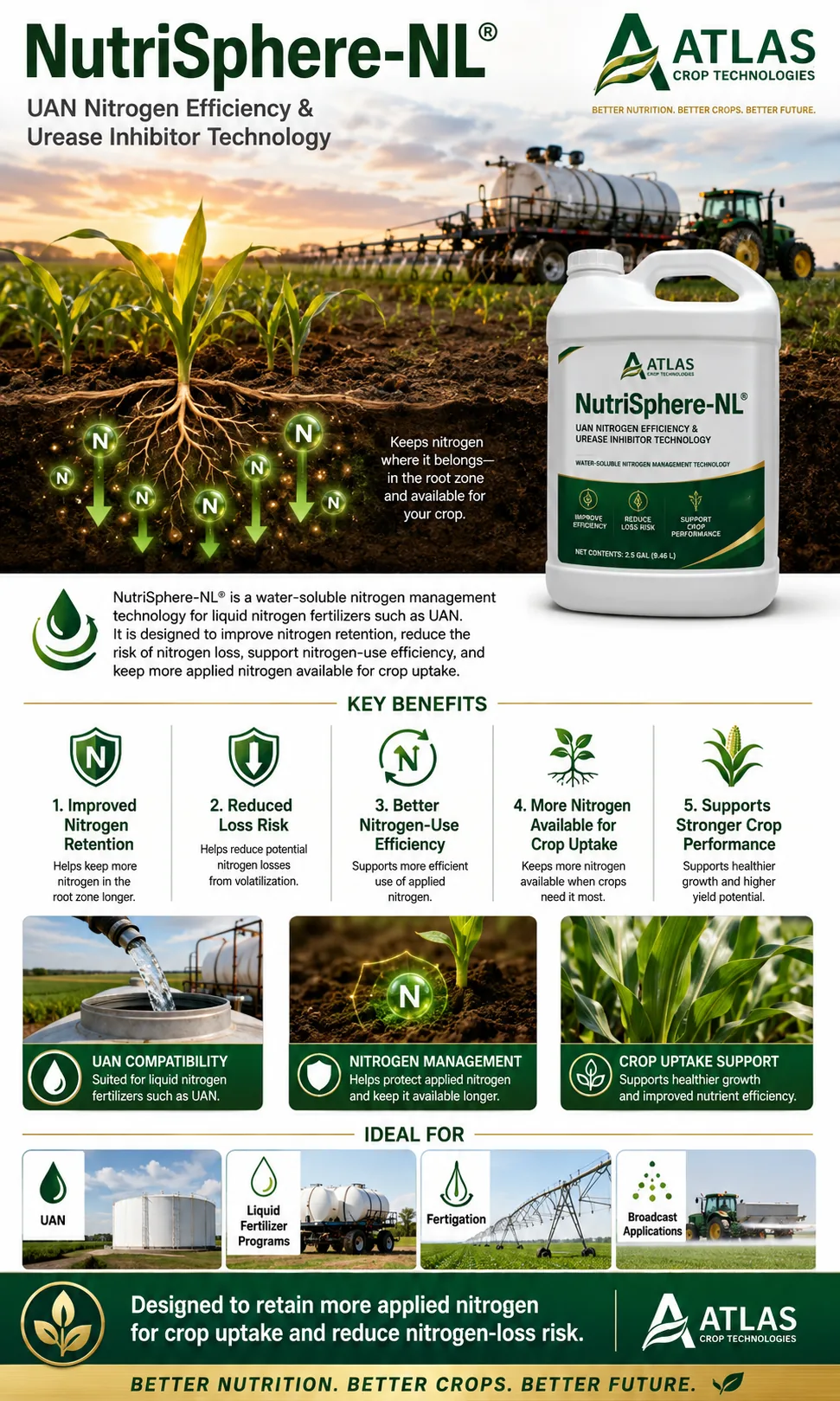
A water-soluble nitrogen-management technology developed for liquid nitrogen fertilisers such as UAN, designed to keep more applied nitrogen in the productive crop system, improve nitrogen-use efficiency and reduce nitrogen-loss risk.
Nitrogen is one of the largest crop-nutrition investments in many production systems, yet applied nitrogen is continuously exposed to chemical, biological and environmental processes that can move it away from crop roots. NutriSphere-NL® is designed to accompany liquid nitrogen fertiliser into this dynamic soil environment and help retain nitrogen in more crop-accessible forms for longer.
Registration, regulatory classification, formulation, rates, nitrogen sources, crops, application methods and permitted claims vary by country. Always read and follow the current approved local product label.
Protecting the value of liquid nitrogen
Nitrogen is essential for proteins, enzymes, chlorophyll, nucleic acids and many of the biochemical processes responsible for crop growth. It is also one of the most dynamic nutrients managed in agricultural soils.
Once nitrogen fertiliser is applied, its different nitrogen forms can be transformed by enzymes, soil microorganisms, water movement and environmental conditions.
Some transformations help supply the crop. Others increase the probability that nitrogen will be lost to the atmosphere or moved beyond the active root zone before crop uptake occurs.
NutriSphere-NL® is positioned specifically for liquid nitrogen fertilisers such as UAN and is designed to improve the proportion of applied nitrogen that remains available within the crop-production system.
Technical positioning
Understanding UAN fertiliser
UAN — urea ammonium nitrate — combines multiple nitrogen forms in one liquid fertiliser, giving it useful handling characteristics while also exposing its nitrogen to several soil transformation pathways.
Urea nitrogen
The urea fraction is converted in soil through urease-mediated hydrolysis. Under certain surface conditions, this process can create an environment favourable to ammonia volatilisation.
Ammonium nitrogen
Ammonium is positively charged and is generally less mobile than nitrate because it can be retained on negatively charged soil exchange sites.
Nitrate nitrogen
Nitrate is immediately available for plant uptake but is also highly mobile in soil water and susceptible to leaching and, under oxygen-limited conditions, denitrification.
Because UAN contains nitrogen in more than one chemical form, different fractions can be exposed to different loss mechanisms at different times after application.
What happens after nitrogen reaches the field?
Nitrogen management is a race between crop uptake and the chemical, biological and physical processes that transform or move nitrogen.
Fertiliser application
UAN introduces urea, ammonium and nitrate nitrogen into the crop production system.
Urea hydrolysis
Soil urease enzymes catalyse conversion of urea, eventually producing ammonium forms.
Ammonium retention
Ammonium can be retained on soil exchange sites and is directly available for crop uptake.
Nitrification
Soil microorganisms can convert ammonium first to nitrite and then to nitrate.
Nitrate movement
Because nitrate is negatively charged, it can move readily with soil water and become susceptible to leaching.
Crop uptake
The agronomic goal is for active roots to capture a high proportion of the available nitrogen before significant losses occur.
Where applied nitrogen can leave the productive system
Different loss mechanisms dominate under different combinations of nitrogen source, soil, weather, water and application method.
Ammonia volatilisation
Surface-applied urea-containing nitrogen may be lost as ammonia gas when environmental and soil-surface conditions favour volatilisation.
Nitrate leaching
Nitrate can move downward with drainage water and may pass below the active root zone before the crop can capture it.
Denitrification
Under oxygen-limited conditions, soil microorganisms can convert nitrate into gaseous nitrogen compounds that leave the soil.
Runoff
Surface movement of water can transport dissolved or particulate nitrogen away from the field depending on soil, slope, rainfall and management.
Nitrification is a transformation, not itself a direct loss
Manufacturer materials sometimes group nitrification with the major processes associated with nitrogen loss risk.
Agronomically, nitrification is the microbial conversion of ammonium into nitrate. Nitrogen remains in the soil during that conversion, so nitrification itself is not the same as volatilisation, leaching or gaseous denitrification loss.
Its importance is that the nitrate produced is substantially more mobile than ammonium and can then become vulnerable to leaching or denitrification.
Nitrogen form affects risk
Designed to travel with liquid nitrogen
Current manufacturer information describes NutriSphere-NL® as fully water soluble.
This allows the product to mix directly with liquid nitrogen fertiliser and move with the fertiliser as it enters the soil.
The technology is therefore positioned around the nitrogen itself rather than being applied as an unrelated standalone field treatment.
Manufacturer information states that this mobility helps protect nitrogen over an extended period while allowing the treated nitrogen to remain available from the beginning of the crop program.
Practical liquid-fertiliser integration
Polymer-based nitrogen-management technology
Current Verdesian technical literature describes NutriSphere technology for UAN as a 40% w/w aqueous solution of maleic-itaconic acid copolymer.
Manufacturer literature also describes the technology as having exchange characteristics that influence the microenvironment around fertiliser nitrogen.
The current local Safety Data Sheet, label and product specification should always be treated as the definitive source for composition.
Do not transfer formulation assumptions between products
NutriSphere product names exist for different nitrogen sources and markets. Do not automatically apply the formulation, application rate or directions of NutriSphere-N®, NutriSphere-N HV®, N-Charge®, Trident® or another Verdesian nitrogen product to NutriSphere-NL®.
Urease and ammonia-volatilisation risk
Urease is a naturally occurring enzyme that catalyses the hydrolysis of urea.
During this reaction, temporary chemical conditions around the dissolving urea can favour ammonia formation. Where the fertiliser remains near the soil surface, some of that ammonia may escape to the atmosphere.
Volatilisation risk is strongly influenced by environmental conditions, fertiliser placement and the time between application and incorporation by rainfall, irrigation or tillage.
CE-marked urease inhibitor
Current Verdesian European information states that NutriSphere-NL® has been assessed by conformity-assessment bodies under applicable European Fertilising Products Regulation requirements.
The manufacturer states that NutriSphere-NL® satisfies the relevant PFC 5C criteria and is CE-marked as a urease inhibitor for the applicable European market.
Confirm the current registration, conformity documentation and permitted claims in the country where the product will be sold or used.
Keeping more nitrogen in the productive system
Nitrogen Retention
NutriSphere-NL® is designed to help retain fertiliser nitrogen within the crop-production system for a longer period.
Nitrogen-Use Efficiency
Keeping a greater proportion of fertiliser nitrogen accessible to roots can improve the opportunity for that nutrient investment to contribute to crop uptake.
Ammonia-Loss Management
European manufacturer positioning includes urease inhibition and reduced ammonia volatilisation risk from urea-containing liquid nitrogen.
Nitrate-Loss Management
Manufacturer field research associates NutriSphere-NL® treatment with reduced detectable nitrate in drainage water under specific trial conditions.
Crop Availability
The central agronomic objective is to maintain nitrogen in the root-zone system long enough for crop uptake to occur.
Environmental Stewardship
Reducing unnecessary nitrogen movement to air or water supports both input efficiency and responsible nutrient management.
Current manufacturer guidance for UAN
Current European Verdesian product information lists:
These figures describe the current European manufacturer page and should not automatically be transferred to another formulation or jurisdiction.
Understanding 0.5% v/v
A 0.5% volume-to-volume treatment rate means that NutriSphere-NL® represents 0.5 litres for every 100 litres of final UAN volume, or 5 litres for every 1,000 litres.
This explanation is provided to interpret the listed European rate. Actual treatment must follow the current approved product directions, including any requirements concerning mixing, measuring, application equipment and nitrogen source.
Bulk handling for liquid fertiliser operations
Current European manufacturer information lists a 946-litre IBC as the NutriSphere-NL® pack size.
Bulk packaging is relevant for commercial liquid-fertiliser terminals, distributors, large farms and blending operations that treat significant UAN volumes.
Maintain traceability
Practical UAN treatment considerations
NutriSphere-NL® is designed for straightforward integration into liquid nitrogen fertiliser systems, but accurate treatment remains important.
Verify the UAN product
Confirm the exact UAN grade, density, nutrient analysis and volume that will be treated.
Calculate treatment quantity
Calculate the NutriSphere-NL® requirement from the approved label rate and actual quantity of UAN.
Meter accurately
Use calibrated pumps, meters or batch-measuring equipment suitable for the liquid-fertiliser operation.
Achieve uniform mixing
Ensure treatment is distributed uniformly throughout the intended UAN volume.
Record the batch
Document UAN source, NutriSphere-NL® lot, treatment rate and final treated volume.
Apply according to agronomic plan
The treated nitrogen should still be applied at the correct crop rate, timing and placement.
Broadcast liquid nitrogen
The source Atlas Crop Technologies page identifies broadcast application as a route for NutriSphere-NL®.
Broadcast UAN may be applied pre-plant, during crop development or according to locally appropriate nitrogen programs.
Surface-applied UAN can experience ammonia-volatilisation risk from its urea-containing fraction, while rainfall and subsequent nitrogen transformations influence nitrate-loss risk.
Match nitrogen management to conditions
Fertigation
The Atlas Crop Technologies source page also identifies fertigation as an application route, subject to local product directions.
Fertigation can coordinate nitrogen supply with irrigation and crop demand, potentially allowing nitrogen to be delivered during key growth stages.
This flexibility does not remove the need to manage nitrogen-loss risk, irrigation uniformity, injection accuracy or compatibility within the irrigation system.
Before injection
Synchronise nitrogen availability with crop demand
Nitrogen stabilisation is most valuable when combined with responsible timing rather than used as a substitute for timing.
Pre-plant nitrogen
Nitrogen applied well before peak crop uptake has a longer period during which weather and soil processes can affect availability.
Early nitrogen
Early nitrogen can support establishment, although crop demand may still be relatively low compared with later rapid growth.
In-season nitrogen
Splitting nitrogen closer to crop demand can reduce the time fertiliser is exposed to loss pathways before uptake.
Multiple in-season applications
Fertigation may allow smaller nitrogen applications to be matched with crop development where irrigation and local management systems support that strategy.
Conditions associated with ammonia volatilisation
Ammonia-volatilisation risk from surface-applied urea-containing nitrogen is influenced by several interacting environmental factors.
Conditions that can increase risk may include surface application, warm conditions, suitable moisture around the fertiliser, rapid surface drying, higher-pH environments and crop residue containing urease activity.
Incorporation by sufficient rainfall, irrigation or tillage can alter this risk by moving nitrogen below the exposed soil surface.
Questions to ask
Nitrate leaching
Nitrate is highly soluble and moves readily with water through the soil profile.
When rainfall or irrigation exceeds the amount retained in the active root zone, nitrate can move downward with drainage water.
Leaching risk tends to be greater when significant nitrate is present during periods of high water movement and relatively low crop nitrogen uptake.
Field conditions matter
Denitrification
Denitrification becomes particularly relevant when nitrate is present in soils where oxygen availability is restricted.
Under waterlogged or saturated conditions, microorganisms can use nitrate in metabolic processes that ultimately generate gaseous nitrogen compounds.
Those gases can leave the soil system, representing a loss of fertiliser nitrogen and, depending on the compound, an environmental concern.
Conditions favouring denitrification
Field and research observations
The following figures come from Verdesian technical material and manufacturer-sponsored or manufacturer-referenced trials. They are presented as research context, not as guaranteed outcomes.
Nitrate in tile-drain outflow
A manufacturer-referenced Iowa grain-maize tile-drain trial reported 42% lower detectable nitrate in outflow two days after application and 21% lower after 290 days for UAN + NutriSphere-NL® compared with standard UAN.
Winter-wheat drainage study
Manufacturer material reports that a Norfolk winter-wheat field-drain trial recorded a consistent 14% reduction and a maximum recorded reduction of 24% in detectable nitrate from UAN + NutriSphere-NL® compared with standard UAN over the stated trial period.
Total nitrogen uptake
A manufacturer-sponsored NIABTAG winter-wheat trial reported total straw-and-grain nitrogen uptake increasing from 265 kg/ha with standard UAN to 289 kg/ha with UAN + NutriSphere-NL®.
Grain protein nitrogen
The same manufacturer technical material reports an increase in grain protein nitrogen of 10.7%, or 23 kg/ha, in the referenced winter-wheat comparison.
European multi-trial summary
Verdesian reports that 62 UK/European NutriSphere-NL® trials over three years and six crops produced an average yield increase of 3.7% in the referenced dataset.
Nitrogen efficiency measurements
More recent manufacturer-reported testing describes increases in agronomic efficiency and apparent nitrogen-recovery efficiency in specific cereal research comparisons.
These are manufacturer-reported observations from specified trials. They do not mean every treated field will produce the same nitrate, nitrogen-uptake, protein or yield response. Results can vary with crop, nitrogen rate, weather, soil, drainage, timing, application quality and other management factors.
What does NUE mean?
Nitrogen-use efficiency is a broad concept describing how effectively the production system converts available nitrogen into crop uptake, yield, protein or other productive output.
Different research programs use different NUE calculations. Agronomic efficiency, recovery efficiency and partial-factor productivity are examples of measurements that answer different questions.
For this reason, NUE figures should always be interpreted together with the calculation method and trial design.
Supply the right N at the right time
NutriSphere-NL® is not a licence to over-apply nitrogen
Improving nitrogen retention does not eliminate the need to select an agronomically and environmentally appropriate nitrogen rate.
Excess nitrogen may remain economically inefficient even when a stabilisation technology is used.
Nitrogen recommendations should reflect the crop, realistic yield potential, soil nitrogen supply, previous crop, organic amendments, irrigation, local research and environmental requirements.
Consider all nitrogen sources
Can the UAN rate be reduced automatically?
No automatic rate reduction should be assumed simply because a nitrogen-efficiency technology is being used.
The crop still requires enough nitrogen to support its realistic production potential after accounting for soil and other nitrogen sources.
Any change in nitrogen rate should be supported by locally validated research, local recommendations and the current approved product label.
Evaluate before changing N rate
Nitrogen risk changes with environmental conditions
Heavy rainfall
Large rainfall events can increase drainage and nitrate movement, especially in lighter or well-drained soils.
Waterlogging
Saturated soils can create oxygen-limited conditions favourable to denitrification.
Warm conditions
Temperature influences enzyme activity, microbial processes and the speed of nitrogen transformations.
Dry surface conditions
Surface-applied urea-containing nitrogen can be exposed to volatilisation risk under certain moist-then-drying conditions.
Drought
Low soil moisture can restrict crop growth and nitrogen uptake even if nitrogen remains present in the soil.
Irrigation
Irrigation can influence incorporation, nitrogen movement and crop uptake depending on timing and volume.
Soil characteristics influence nitrogen behaviour
Texture
Sandy soils often have lower water-holding capacity and may be more vulnerable to nitrate movement under high drainage.
Cation exchange capacity
Soil exchange properties influence retention of positively charged ions such as ammonium.
Organic matter
Organic matter contributes to nitrogen mineralisation, immobilisation, microbial activity and water-holding characteristics.
Soil pH
Soil pH influences ammonia chemistry, biological activity and multiple nutrient-management processes.
Drainage
Poor drainage can favour oxygen limitation, while rapid drainage can increase nitrate-leaching risk.
Biological activity
Soil microorganisms drive nitrification, denitrification, mineralisation and immobilisation processes.
Use NutriSphere-NL® within a complete nutrient strategy
Nitrogen stabilisation should complement — not replace — fundamental nutrient-management practices.
A well-designed program should align nitrogen source, rate, timing and placement with crop demand and environmental conditions.
Stabilisation technology then provides an additional management tool for reducing the risk that nitrogen is lost before the crop can use it.
Right source · rate · time · place
Air quality and ammonia
Ammonia lost from fertiliser is nitrogen that is no longer available to the crop.
It also becomes part of the wider atmospheric nitrogen cycle. Technologies and management practices that limit unnecessary volatilisation can therefore support both fertiliser efficiency and air-quality objectives.
Water quality and nitrate
Nitrate is highly mobile and can move with drainage water into groundwater or surface-water systems.
Nitrogen management that reduces the amount of nitrate exposed to major drainage events can contribute to improved nutrient retention within the crop-production system.
Nitrogen availability must ultimately translate into crop uptake
Retaining nitrogen in soil is useful only if the crop has the root activity and physiological demand required to take advantage of that nitrogen.
Root health, soil moisture, temperature, crop stage and supporting mineral nutrients all influence nitrogen uptake.
NutriSphere-NL® should therefore be considered within the complete crop-production program rather than as an isolated input.
Nitrogen does not work alone
Liquid fertiliser and tank-mix considerations
NutriSphere-NL® is designed to mix with liquid nitrogen fertiliser, but complex tank mixtures may contain additional nutrients, pesticides or other additives.
The physical and chemical compatibility of the complete mixture should be confirmed rather than assuming that compatibility with UAN guarantees compatibility with every additional material.
Check the complete program
Protect product quality before application
Follow storage temperature guidance
Store NutriSphere-NL® according to the current label and Safety Data Sheet, including any temperature limitations.
Keep containers identified
Product identity, lot number and regulatory information should remain clearly traceable throughout commercial storage and use.
Use compatible equipment
Pumps, seals, hoses, meters and storage materials should be suitable for the product and fertiliser system.
Prevent cross-contamination
Liquid-fertiliser handling equipment should be managed to prevent contamination with incompatible materials.
Follow PPE guidance
Consult the current Safety Data Sheet for required personal protective equipment and safe handling procedures.
Manage spills correctly
Follow local environmental and workplace procedures for containment, clean-up and disposal.
Situations where nitrogen stabilisation may warrant evaluation
Surface-applied UAN
Programs in which significant urea-containing nitrogen remains on the soil surface may warrant greater attention to volatilisation risk.
Early-applied nitrogen
Nitrogen applied well before peak crop demand can spend more time exposed to environmental loss pathways.
High-rainfall environments
Strong drainage can increase nitrate-leaching risk, particularly where soil texture and timing permit rapid movement.
Irrigated systems
Nitrogen and irrigation management can be closely integrated, making both timing and nitrate movement important considerations.
High nitrogen investment
Protecting the agronomic value of a significant liquid-nitrogen input may be economically important where loss risk is meaningful.
Environmental stewardship programs
Nitrogen-retention strategies may fit programs designed to improve nutrient-use efficiency and reduce avoidable nitrogen movement to air or water.
Evaluate the nitrogen program, not only the product
Crop colour and biomass
Crop appearance can provide context, although colour alone is not a reliable measurement of nitrogen-use efficiency.
Tissue nitrogen
Plant analysis may help evaluate crop nitrogen status at defined growth stages.
Soil mineral nitrogen
Where locally appropriate, soil nitrate and ammonium measurements can provide additional information about nitrogen supply.
Yield
Well-designed treated and untreated comparisons can help evaluate whether the program produced an agronomic response.
Grain protein
In cereal systems, grain protein can provide another indicator of nitrogen status and nitrogen partitioning.
Nitrogen balance
Input, crop removal and residual nitrogen information can help assess the broader efficiency of the nitrogen-management strategy.
Information that helps us evaluate program fit
Detailed nitrogen and field information enables a more relevant technical recommendation.
Country and region
Location determines registration and helps place the nitrogen program in its local soil, climate and regulatory context.
Crop
Include crop, variety where relevant, planting date and expected yield level.
UAN grade
Specify the UAN analysis or other approved liquid nitrogen source being used.
Nitrogen rate
Provide total N per hectare or acre and identify how much comes from the treated liquid fertiliser.
Application timing
Indicate whether nitrogen is pre-plant, at planting, sidedress, split-applied or fertigated.
Application method
Describe broadcast, streamed, banded, injected or fertigation use.
Soil information
Soil texture, pH, organic matter, drainage and irrigation provide important nitrogen-loss context.
Weather risk
Include rainfall, irrigation or drainage conditions relevant to the application window.
Commercial requirement
For distribution enquiries, include expected UAN volume, NutriSphere-NL® requirement, market and season.
NutriSphere-NL® product profile
What NutriSphere-NL® does not replace
Nitrogen-rate planning
Nitrogen stabilisation does not remove the need to determine a crop-appropriate nitrogen rate.
Correct application timing
Keeping nitrogen closer to crop demand remains an important management strategy.
Drainage management
A fertiliser additive cannot correct severe waterlogging or poor field drainage.
Irrigation management
Excessive irrigation can still move nitrate beyond the root zone.
Balanced fertility
Nitrogen response depends on adequate phosphorus, potassium, sulphur and micronutrient nutrition.
Regulatory compliance
All nitrogen and fertiliser applications must continue to meet local nutrient-management and environmental requirements.
Explore related technologies
Combine nitrogen-efficiency technology with phosphorus, micronutrient and plant-development tools according to crop needs and local registration.
Phorce
A foliar nutrient complex powered by Nutriphite® and positioned to support root development, nutrient uptake and nutrient utilization.
View Product → Phosphorus EfficiencyPhree-Up®
A phosphorus-efficiency technology designed to help protect applied phosphorus and make bound soil phosphorus more available.
View Product → MicronutrientsPolyAmines
A range of amino-acid-chelated micronutrients designed to support trace-element nutrition, efficient uptake and crop development.
View Product →Build a more efficient liquid-nitrogen program
Tell us your country, crop, UAN grade, nitrogen rate, timing, application method, soil conditions and expected treated-fertiliser volume. Atlas Crop Technologies can help evaluate how NutriSphere-NL® may fit your technical or commercial program.
Frequently Asked Questions
These answers combine current manufacturer information with general nitrogen agronomy. The current approved local label remains the definitive source for product use.
NutriSphere-NL® is a water-soluble nitrogen-management technology developed for liquid nitrogen fertilisers such as UAN. It is designed to improve nitrogen retention and nitrogen-use efficiency while reducing nitrogen-loss risk.
NutriSphere-NL® is the product designation used by Verdesian for the liquid-nitrogen version of its NutriSphere technology in the relevant markets. Always use the full product name when checking label, SDS and technical information because other NutriSphere formulations also exist.
Current manufacturer information specifically positions NutriSphere-NL® for liquid nitrogen fertilisers such as UAN. Confirm the exact approved nitrogen sources on the current local label.
UAN means urea ammonium nitrate. It is a liquid nitrogen fertiliser containing nitrogen in urea, ammonium and nitrate forms. Those forms behave differently after application and can be exposed to different nitrogen-loss processes.
Applied nitrogen can be transformed or moved before crop roots capture it. Depending on fertiliser form and field conditions, nitrogen may be lost through ammonia volatilisation, nitrate leaching, denitrification or runoff.
Ammonia volatilisation is the movement of fertiliser nitrogen into the atmosphere as ammonia gas. Surface-applied urea-containing nitrogen such as UAN can be susceptible under favourable environmental conditions.
Nitrification is the microbial conversion of ammonium into nitrate. The process itself does not directly remove nitrogen from the soil, but the resulting nitrate is more mobile and can subsequently become susceptible to leaching or denitrification.
Nitrate leaching occurs when nitrate moves downward with water below the active crop root zone. Risk depends on soil texture, drainage, rainfall or irrigation, crop uptake and the quantity of nitrate present.
Denitrification is a biological process that can occur under oxygen-limited conditions when microorganisms convert nitrate into gaseous nitrogen compounds. Those gases can leave the soil system.
No nitrogen-management technology can prevent every loss under every environmental condition. NutriSphere-NL® is positioned to reduce nitrogen-loss risk and improve retention, but performance remains dependent on weather, soil, nitrogen rate, timing and other management factors.
Yes. Current Verdesian European information describes NutriSphere-NL® as fully water soluble. The manufacturer states that this allows it to mix easily with liquid fertiliser and move with that fertiliser into the soil.
Verdesian technical literature describes the UAN NutriSphere technology as a 40% by-weight aqueous solution of maleic-itaconic acid copolymer. Always consult the current local SDS and label for definitive formulation information.
Current European manufacturer information states that NutriSphere-NL® has been assessed under the applicable European Fertilising Products Regulation framework and CE-marked as a urease inhibitor under the stated PFC 5C criteria.
Urease-inhibitor technologies are used to reduce or delay urease-driven transformation of urea in ways intended to lower ammonia-volatilisation risk. Product-specific mode of action and regulatory claims should be taken from the approved label.
Current European manufacturer information lists 5 litres of NutriSphere-NL® per 1,000 litres of UAN, equal to 0.5% of total liquid volume, or 3.9 litres per 1,000 kg of UAN. Always confirm your local product label before treatment.
Commercial liquid-fertiliser operations may meter UAN by either volume or mass. The manufacturer therefore provides equivalent treatment guidance in both systems for the referenced European product.
Current European Verdesian information lists a 946-litre IBC. Packaging may vary by country and supply channel.
The Atlas Crop Technologies source page identifies broadcast and fertigation applications. Exact crops, nitrogen sources, timing, rates and permitted application methods must follow the current approved local label.
Fertigation is listed on the Atlas Crop Technologies product page. Confirm that your market label, irrigation system and nitrogen source support this use before injection.
Broadcast is listed as an application route on the Atlas Crop Technologies page. Exact application timing and rate should follow the current local label and nitrogen recommendation.
No. NutriSphere-NL® is a nitrogen-management technology intended to improve the efficiency of nitrogen that is already part of the crop fertility program. It does not create nitrogen or remove the crop's fundamental nitrogen requirement.
No automatic rate reduction should be assumed. Any nitrogen-rate change should be supported by local agronomic recommendations, crop requirements, soil nitrogen supply, validated research and the approved label.
Current manufacturer information states that its water-soluble characteristics help protect nitrogen over several months. Actual field behaviour and the permitted wording of this claim should be interpreted from the current regional label and technical documentation.
Manufacturer information states that the product's solubility allows treated nitrogen to be available from the start while the technology moves with liquid fertiliser into the soil.
Verdesian technical material references US and UK field-drain trials in which UAN + NutriSphere-NL® produced lower detectable nitrate concentrations in drainage water than standard UAN under those specific trial conditions.
Manufacturer-sponsored UK winter-wheat research cited by Verdesian reports greater total crop nitrogen uptake for UAN + NutriSphere-NL® than standard UAN under the stated trial conditions.
No. Manufacturer trial summaries report positive average yield responses across certain trial datasets, but individual field results can vary and no specific yield response should be guaranteed.
Nitrogen-loss risk does not disappear during drought, especially where surface-applied urea-containing nitrogen is exposed to volatilisation. However, nitrogen stabilisation cannot correct the crop-growth and nutrient-uptake limitations caused by severe lack of soil moisture.
Wet conditions can increase nitrate movement and, in saturated soils, denitrification risk. A nitrogen-management technology may help reduce exposure to some nitrogen-loss pathways, but it cannot prevent all losses under severe flooding or prolonged saturation.
Compatibility should be confirmed for the complete mixture. Although NutriSphere-NL® is designed for liquid nitrogen fertiliser, that does not automatically establish compatibility with every pesticide, micronutrient, biological or other tank additive.
The technology is positioned to reduce nitrate-loss risk from fertiliser nitrogen, and manufacturer field research has reported reduced detectable nitrate in drainage water under specific conditions. Water quality is influenced by many sources and management factors, so no single product should be described as independently determining water quality.
Reducing ammonia loss from fertiliser can support air-quality objectives because less fertiliser nitrogen escapes to the atmosphere. The current European product positioning includes urease-inhibitor and ammonia-loss-management claims.
Current Verdesian information states that NutriSphere-NL® has CE-mark status under the stated EU fertilising-product framework as a urease inhibitor. Commercial availability, national requirements and product documentation should still be confirmed for the intended market.
Product availability and registration differ by market. EU conformity status should not be assumed to establish registration elsewhere. Contact Atlas Crop Technologies for current regional availability.
Include your country, crop, soil type, expected yield, UAN grade, total nitrogen rate, application timing, application method, irrigation information, soil drainage and any other products intended in the tank.
Include your company, country, target market, expected UAN volume, estimated NutriSphere-NL® requirement, customer segment, delivery timing and whether the enquiry concerns farm use, distribution or liquid-fertiliser manufacturing.
Use the contact form on this page or email contact@fertilizercoatingproducts.com. Providing your country, crop and nitrogen program will help route the enquiry to the appropriate regional or technical contact.
This page provides general product and nitrogen-management information only. NutriSphere-NL® formulation, composition, regulatory classification, CE-mark status, approved nitrogen sources, crops, application rates, application routes, timings, pack sizes, storage requirements and permitted claims may differ by jurisdiction.
The application rate of 5 L per 1,000 L UAN, equivalent to 0.5% v/v, the alternative 3.9 L per 1,000 kg UAN rate and the 946 L IBC pack size reflect current European manufacturer information and should not automatically be transferred to another market.
References to a 40% w/w aqueous solution of maleic-itaconic acid copolymer are based on manufacturer technical literature. The current local product label, specification and Safety Data Sheet remain the definitive sources for formulation information.
Research figures presented on this page are manufacturer-reported, manufacturer-sponsored or manufacturer-referenced observations from specified trials. They are not guarantees of nitrogen retention, nitrate reduction, protein, nitrogen uptake, yield or financial return under an individual field's conditions.
Nitrogen-loss pathways depend on fertiliser form, soil, rainfall, irrigation, temperature, drainage, crop uptake, biological activity and management. No stabiliser can prevent every nitrogen loss under every condition.
NutriSphere-NL® should not be interpreted as a universal replacement for nitrogen fertiliser or as automatic justification for reducing the agronomically required nitrogen rate. Nitrogen recommendations should be based on crop requirement, soil nitrogen supply, expected yield, previous crop, organic nutrient sources, local research, environmental regulations and qualified agronomic advice.
Always read and follow the current approved product label, Safety Data Sheet and local fertiliser regulations. Consult a qualified agronomist, crop adviser or Atlas Crop Technologies representative where crop-specific recommendations, compatibility assessment, nitrogen-rate planning or local registration confirmation is required.